
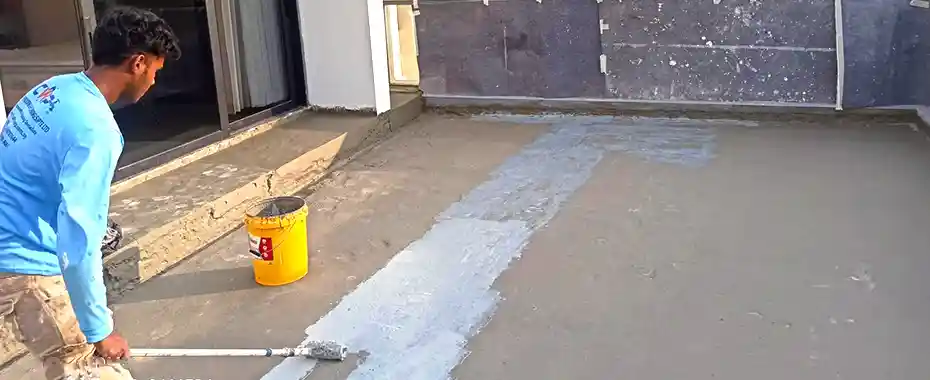
Balcony waterproofing stops water from damaging your balcony floor. Workers apply protective coatings and membranes to seal the concrete surface. This process prevents rainwater from seeping through cracks below. Waterproofing keeps your balcony dry and safe in all weather. It protects the building structure from costly water damage.
Good balcony waterproofing creates a barrier between water and concrete. The waterproof layer stops moisture from entering and causing dampness. It prevents mould growth that damages paint and plaster badly. Waterproofing also stops metal reinforcement bars from rusting over time. This treatment extends your balcony’s life for many years.
Professional contractors use different materials and methods in Singapore’s climate. They carefully prepare surfaces by cleaning and repairing cracks first. The waterproofing must handle heavy tropical rain, hot sun, and daily use. Quality waterproofing creates a seamless protective layer that lasts long. Regular maintenance and inspections help the waterproofing continue working perfectly.
Why is Balcony Waterproofing Important?
Balcony waterproofing protects your home from serious water damage and leaks. Without waterproofing, rainwater enters through cracks and damages rooms inside. Water seepage causes paint to peel, walls to crack, and ugly staining. It weakens the concrete structure and makes balconies dangerous over time. Waterproofing saves you thousands of dollars in expensive repairs.
Key reasons balcony waterproofing matters:
- It prevents water from leaking into rooms and damaging belongings.
- It stops mould and mildew that causes family health problems.
- It protects steel bars from rusting and weakening the entire structure.
- It maintains your property value as buyers want leak-free homes.
- It reduces repair costs by avoiding frequent ceiling damage fixes.
- It keeps your balcony floor safe and prevents dangerous slips.
- It extends balcony lifespan by protecting concrete from cracking.
What Are the Different Types of Balcony Waterproofing?
Balcony waterproofing types include cementitious coatings and liquid membranes. Workers also use polyurethane systems, bituminous coatings, and sheet membranes. Some balconies need tile-over systems; others use nano waterproofing technology. Each type offers special benefits and suits different balcony conditions. Choosing the right type depends on your balcony’s age and damage.
1. Cementitious Balcony Waterproofing
Cementitious balcony waterproofing uses a cement-based coating with waterproofing chemicals. Workers mix the powder with water and apply it using brushes or rollers. This coating forms a hard layer that bonds strongly with concrete. It works well for balconies needing durable protection against heavy rain. Cementitious balcony waterproofing remains one of the most popular options in Singapore.
Benefits and Uses:
- It costs less than other balcony waterproofing methods on the market.
- It applies easily and workers finish small balconies in one day.
- It creates a breathable layer that lets moisture escape safely.
- It handles Singapore’s hot and humid weather without cracking.
- It works perfectly under tiles for new flooring installation.
- It lasts ten to fifteen years when applied with good preparation.
- It fixes minor cracks and seals the surface against water penetration.
A study from the Forest Service Research and Development (R&D) entitled “Durable solutions for balconies and decks” showed that wood-framed balconies and decks are highly vulnerable to moisture damage. Poor design, construction defects, and water infiltration have caused major structural failures, including the Berkeley Balcony Collapse and Chicago Balcony Collapse, highlighting the critical need for proper waterproofing and construction practices. Another study conducted by MATEC Web of Conferences titled “Assessment of cantilevered concrete balconies by means of practically oriented evaluation tools” showed that aging reinforced concrete balconies face structural risks from corrosion, poor reinforcement placement, and increased loads. Proper inspection, diagnosis, and condition assessment are essential before repairs. A structured evaluation protocol helps determine bearing capacity, residual lifespan, and select durable balcony waterproofing and repair strategies.
2. Liquid Balcony Waterproofing Membrane
Liquid balcony waterproofing membrane is a coating workers paint or roll on. It comes in buckets as a thick liquid that spreads easily everywhere. When it dries, it forms a seamless rubber-like layer that stretches. This membrane creates perfect protection because it has no joints. Liquid membranes work brilliantly for balconies with complicated shapes and corners.
Why Choose Liquid Membrane:
- It covers every crack, gap, and corner without leaving weak spots.
- It creates a flexible coating that moves with the building.
- It applies quickly and dries fast for early balcony use.
- It works on concrete, tiles, and metal drains without problems.
- It resists UV rays and does not fade or weaken quickly.
- It lasts fifteen to twenty years with regular cleaning and maintenance.
- It seals around pipes, drains, and fixtures to prevent leaks.
A study from SSRN entitled “Water-Resistance Performance Analysis of Portland Composite Concrete Containing Waterproofing Liquid Membrane”, showed that adding a liquid waterproofing membrane admixture (1.5%) to Portland composite cement significantly improves density, reduces water absorption, and enhances strength. The treated concrete achieved performance close to OPC, making it a cost-effective solution for water-resistant structures in heavy rainfall area. Another study conducted by MATEC Web of Conferences showed that liquid migration causes roof leaks, rising damp, basement seepage, and environmental contamination. Selecting the right liquid waterproofing membrane as a hydraulic barrier is essential to ensure structural durability, prevent costly repairs, and provide long-term protection for underground and exposed structures.
3. PU (Polyurethane) Balcony Waterproofing
PU balcony waterproofing provides excellent elastic protection for your balcony. Workers apply a liquid that turns into a strong rubber membrane when dry. It stretches up to three hundred percent without breaking. PU balcony waterproofing handles temperature changes and weather in Singapore perfectly. This premium option costs more but lasts significantly longer.
Advantages of PU Waterproofing:
- It creates an extremely flexible membrane that moves with your structure.
- It resists chemicals, oils, and harsh cleaning products without weakening.
- It bonds to most surfaces and creates a very strong seal.
- It handles foot traffic well and does not wear out quickly.
- It applies in thin layers but provides better protection overall.
- It lasts twenty to twenty-five years for excellent long-term value.
- It creates a smooth, attractive finish that looks professional and clean.
A study from Science Direct entitled “Experimental investigation on mechanical properties of polyurethane modified bituminous waterproofing membrane”, showed that Liquid migration can cause costly leaks, rising damp, and structural damage over time. PU (Polyurethane) balcony waterproofing acts as an effective hydraulic barrier, preventing water penetration, improving durability, and ensuring long-term structural stability while offering sustainable and cost-efficient protection solutions. Another study from Wiley Online Library entitled “Bioinspired Robust Mechanical and Waterproofing Properties of Moisture-Curing Polyurethane With Multiple Hydrogen Bonding Networks” showed that advanced PU (Polyurethane) balcony waterproofing improves strength and flexibility by enhancing molecular bonding. Modified moisture-curing polyurethane achieves higher tensile strength, extreme elongation, and excellent water resistance, withstanding prolonged static and dynamic pressure, making it highly durable for balcony waterproofing applications.
4. Bituminous Balcony Waterproofing
Bituminous balcony waterproofing uses a tar-like material creating a thick protective layer. Workers apply it in multiple layers to build strong protection. This traditional balcony waterproofing method has worked reliably for many decades. It works well for balconies that face heavy rain or serious leakage. Bituminous balcony waterproofing costs less than modern systems.
Uses and Benefits:
- It creates a very thick barrier that blocks water and prevents leaks.
- It sticks strongly to concrete and seals even large cracks.
- It handles extreme weather including heavy tropical rain and intense heat.
- It costs much less than polyurethane or liquid membrane systems.
- It lasts fifteen to twenty years when workers apply it correctly.
- It works well for basement-level balconies facing high moisture.
- It repairs easily by adding new layers over the old coating.
A study from Scientific Reports entitled “The durability of mechanical properties of flexible waterproofing membranes used on ventilated terraces under long term exposure to high temperatures” showed that reinforced bitumen sheets performed strongly under 70 °C ageing for 12 weeks, increasing impact resistance by 36% and maintaining 20 kg puncture resistance. EPDM membranes saw a 25% drop in impact resistance, highlighting the durability advantage of bituminous systems. Another study from the International Journal for Research in Applied Science and Engineering Technology (IJRASET) showed that Bituminous membrane waterproofing effectively protects building components, including balconies, roofs, and wet areas, from water infiltration. Proper application prevents concrete deterioration, steel corrosion, and mould growth, ensuring long-term durability, structural integrity, and a safe, dry living environment.
5. Sheet Membrane Balcony Waterproofing
Sheet membrane balcony waterproofing uses large waterproof sheets stuck onto surfaces. These sheets come in rolls and contractors cut them to fit precisely. Workers use special adhesive to stick sheets down and overlap the edges. This method creates a strong, durable waterproofing layer that lasts long. Sheet membrane balcony waterproofing works well for large balconies needing quick installation.
Why Use Sheet Membrane:
- It installs faster than liquid coatings for large balcony areas.
- It provides consistent thickness because sheets come pre-made from the factory.
- It resists punctures and tears better than painted-on coatings.
- It lasts twenty to thirty years as one of the longest-lasting options.
- It handles building movement well because sheets can stretch slightly.
- It works well in areas with high water pressure or dampness.
- It requires less maintenance than other waterproofing types over its lifespan.
A study from Academic Journal of Research and Scientific Publishing (AJRSP) entitled “Comparison between Waterproofing Sheets Membrane and Polyurea Waterproofing Coating Methods” showed that it is a cost-effective method taking 5 to 7 days to apply, offering up to 20 years of durability. Proper surface preparation and 3-day testing ensure effective moisture protection, making it a reliable solution. Another study from MDPI entitled “A Study of the Field Test Method for the Adhesive Performance Evaluation of Self-Adhesive Waterproofing Sheets”, showed that develops a field-applicable adhesion measurement device for self-adhesive waterproofing sheets. Comparative analysis shows a standard deviation of 0.17 for UTM and 0.18 for the portable device, indicating similar results and potential for wider field use.
6. PU Injection Balcony Waterproofing
PU injection balcony waterproofing fixes leaks by injecting polyurethane foam into cracks. Workers drill small holes and pump PU liquid that expands and fills gaps. The foam hardens quickly and seals cracks from inside the concrete. This method works brilliantly for balconies with active leaks. PU injection repairs problems without removing tiles or damaging existing flooring.
Benefits of PU injection balcony waterproofing:
- It fixes leaks quickly without removing tiles or breaking concrete.
- It works from inside cracks and seals them permanently.
- It expands to fill even the tiniest gaps you cannot see.
- It hardens in minutes and stops leaks immediately after injection.
- It costs less than removing and replacing entire balcony floors.
- It works well for difficult leaks around drains, corners, and joints.
- It lasts many years and often solves leak problems permanently.
A study from the International Mine Water Association (IMWA) entitled “Water Control using polyurethane resins”, showed that Water reactive polyurethane (PU) resins, with viscosities of 130 to 350 cps and densities of 1.05–1.12 g/cm³, effectively seal cracks and joints, reduce ground permeability, and provide durable waterproofing, with gel time controlled by catalysts and drill spacing typically 1 m apart. Another study conducted at Nanotechnologies in Construction: A Scientific Internet-Journal entitled “The features of the implementation of injection technologies using polymer-based compositions with adjustable parameters for underground construction.” PU injection for balcony waterproofing uses polyurethane mixtures that expand up to 20×, achieving densities from 30–1300 kg/m³ and local pressures up to 10 MPa, enhancing soil stabilization, sealing leaks, and improving water resistance within 6 to 24 hours.
7. Tile-Over Balcony Waterproofing System
Tile-over balcony waterproofing allows workers to apply protection over existing tiles. This system uses special primers and membranes that stick to tiles directly. It saves time and money because you do not need to break tiles. Workers prepare the surface, apply the membrane, and install new tiles on top. This balcony waterproofing system works well when you need quick results.
Advantages of the tile-over balcony waterproofing system:
- It saves money because workers do not remove or dispose of old tiles.
- It finishes faster and causes less mess and disruption at home.
- It works on ceramic, porcelain, and natural stone tiles.
- It creates a waterproof layer that protects as well as traditional methods.
- It lets you change your balcony’s look with new tiles on top.
- It reduces noise and dust during work, keeping neighbours happy.
- It lasts ten to fifteen years and you can reapply it when needed.
8. Nano Waterproofing for Balconies
Nano balcony waterproofing uses tiny particles that penetrate deep into concrete pores. Nano waterproofing advanced technology creates a waterproof barrier at the molecular level. Workers spray or brush the nano coating onto surfaces and it soaks in. You cannot see nano balcony waterproofing but it blocks water while allowing airflow. This solution works well for balconies where you want invisible protection.
Benefits of Nano Technology:
- It penetrates deep into concrete and protects from inside the material.
- It remains completely invisible and does not change the surface colour.
- It allows concrete to breathe naturally whilst blocking water ingress.
- It applies very quickly and dries in hours for fast balcony use.
- It resists dirt and oil, keeping your balcony cleaner for longer.
- It lasts five to ten years and you can reapply it easily.
- It works well for heritage buildings where you cannot change the appearance.
A study from the American Chemical Society (ACS) entitled “Sand-Based Economical Micro/Nanocomposite Materials for Diverse ApplicationsArticle link copied!” showed that micro/nanostructured superhydrophobic sand, created via one-step silicone nanofilament growth, achieves over 90% water repellency. This low-cost, efficient material enhances waterproofing, water storage, soil moisture, and oil–water separation for construction applications.
What Are the Common Signs of Balcony Water Leakage?
Common signs of balcony water leakage include water stains on ceilings below. You may notice damp patches, peeling paint, or bubbling plaster near balconies. Puddles form on your balcony floor even during dry weather. Tiles become loose or hollow-sounding when you tap them gently. Grout between tiles cracks and allows water to seep into concrete.
Warning Signs to Watch:
- Ceiling stains appear as yellow or brown patches that grow bigger slowly.
- Paint peels off walls in sheets and plaster becomes soft to touch.
- Mould and mildew grow in corners creating black or green spots.
- Water drips from ceiling lights or fans directly below your balcony.
- Floors feel damp or wet during dry weather without any rain.
- Cracks appear on the balcony floor and walls, allowing water entry.
- Rust stains show on balcony surfaces where steel bars are corroding inside.
What Are the Best Balcony Waterproofing Products and Materials?
The best balcony waterproofing products include polyurethane membranes and acrylic coatings. Popular Singapore brands like Sika, Fosroc, and BASF make excellent waterproofing products. You can also use bitumen-based membranes and modern nano waterproofing solutions. Sheet membranes from brands like Derbigum and Grace work well for large balconies. You can also use epoxy sealers for chemical-resistant balcony surface protection. Choosing quality materials from trusted manufacturers ensures lasting balcony waterproofing protection. 5 recommended balcony waterproofing products and materials:
1. Sika Sikalastic polyurethane membrane: flexible, long-lasting, UV-resistant balcony waterproofing.
2. Fosroc Brushbond waterproofing coating: cement-based, easy application, strong adhesion.
3. BASF MasterSeal liquid membrane: seamless, high-elongation balcony waterproofing protection.
4. Derbigum sheet membrane: pre-formed, consistent thickness, excellent puncture resistance.
5. Mapei Mapelastic acrylic coating: flexible, two-component, crack-bridging waterproof membrane.
How Do You Repair Leaks Using Balcony Waterproofing?
Repair balcony leaks by following systematic steps to fix problems permanently. Workers first find all leak sources by inspecting cracks and damaged tiles. They clean the entire balcony surface and remove loose materials. Next, they fill cracks with special sealants and prepare surfaces. Finally, they apply balcony waterproofing membranes and test thoroughly before finishing.
Step 1: Start by Checking Cracks
Start by checking cracks: inspect your entire balcony carefully for damage. Workers look for visible cracks in floor tiles, walls, and drain areas. They tap tiles to find hollow spots where water may be trapped. They check expansion joints, corners, and edges where cracks often appear first. Using moisture meters, they detect hidden dampness and where water enters. Finding all problems first helps workers plan the best balcony waterproofing repair.
Step 2: Prepare the Balcony Surface
Prepare the balcony surface by cleaning and removing all dirt and loose materials. Workers sweep away debris and wash the balcony with cleaning solutions. They remove damaged tiles, old waterproofing, and crumbling concrete thoroughly. They grind down rough spots and make the surface smooth and even. They let the balcony dry completely before applying any balcony waterproofing product. Good preparation ensures balcony waterproofing bonds strongly and lasts for years.
Step 3: Fill Cracks Using PU Injection or Sealants
Fill cracks using PU injection or sealants to seal every gap permanently. Workers drill small holes along cracks and inject expanding polyurethane foam. The foam expands deep into cracks and hardens to create a watertight seal. For smaller cracks, they use flexible sealants that bend with building movement. They fill expansion joints with special materials that allow movement without leaking. Proper crack filling stops water from entering and prevents future balcony damage.
Step 4: Apply Balcony Waterproofing Material
Apply balcony waterproofing material in thin, even layers covering the entire surface. Workers start with a primer coat that helps balcony waterproofing stick better. They paint or roll the membrane onto the floor, working from corners outward.
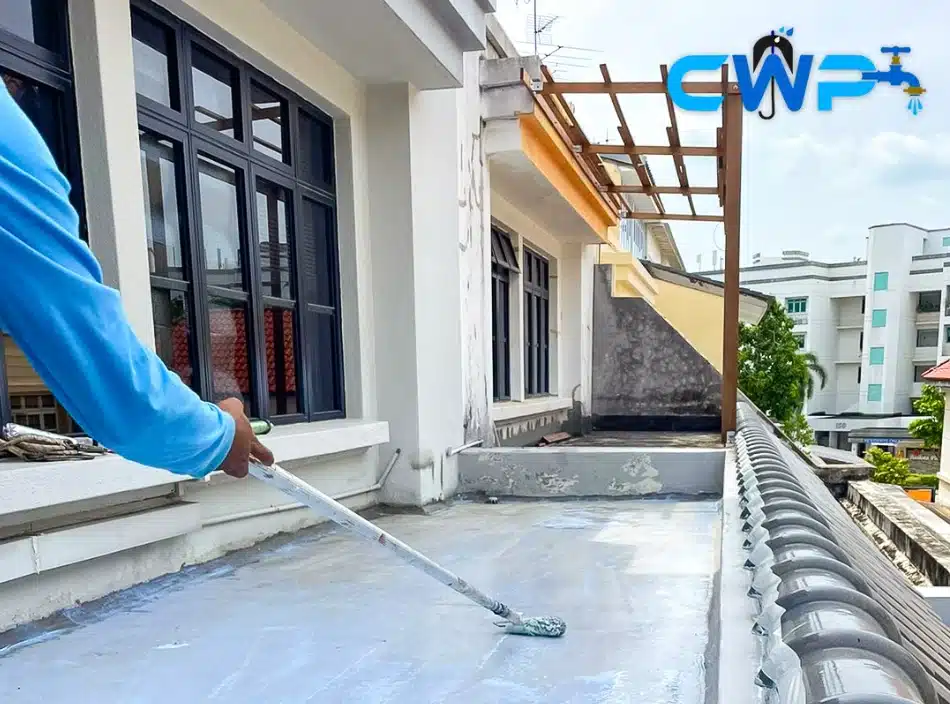
They apply extra coats around drains, pipes, and edges where leaks occur most. They let each layer dry properly before adding the next coat. They apply at least two to three coats to build strong balcony waterproofing protection.
Step 5: Protect and Finish the Surface
Protect and finish the surface by adding a layer over the waterproofing membrane. Workers apply a cement screed or protective coating to prevent foot traffic damage. They install new tiles if needed using waterproof tile adhesive and grout. They seal all joints and edges to ensure no water can enter. They install proper drainage to ensure water flows away from the balcony quickly. Finally, they test the balcony waterproofing by flooding the area and checking for leaks.
How Do You Hire a Balcony Waterproofing Contractor?
Hire a balcony waterproofing contractor by researching companies and checking their experience. You must verify they specialise in balcony waterproofing and know Singapore’s building codes. Check their licences, insurance, and certifications to confirm they work professionally. Ask for references and look at their previous balcony waterproofing projects. Compare quotes from at least three contractors and choose the best value. Make sure they provide written warranties and clear contracts before starting work.
- Check Experience and Specialisation
Check experience and specialisation by asking how many years they have worked. You want contractors who focus mainly on balcony waterproofing, not general work. Ask how many balconies they waterproof each year and what types they handle. Experienced contractors know which balcony waterproofing methods work best for each problem. They understand Singapore’s climate and use materials that handle tropical conditions. Specialists solve balcony waterproofing problems faster and deliver better quality work.
- Verify Licences and Certifications
Verify licences and certifications by checking the contractor has valid business registration. They must hold proper licences from Singapore’s Building and Construction Authority. Ask to see certifications from balcony waterproofing product manufacturers showing training. Check if workers have safety certifications and insurance to protect you. Licensed contractors follow safety rules and building codes properly. Valid certifications prove the contractor knows correct balcony waterproofing methods.
- Review Past Work and Online Reviews
Review past work and online reviews to assess the contractor’s quality and reliability. Ask for photos of completed balcony waterproofing projects from Singapore. Contact previous customers and ask about their experience with the contractor. Check Google reviews, Facebook ratings, and other platforms for honest feedback. Look for patterns in reviews that mention quality, punctuality, and problem-solving. Good contractors have many positive reviews and happy customers who recommend them.
- Ask for a Site Inspection
Ask for a site inspection before hiring any balcony waterproofing contractor. Good contractors visit your home and examine the balcony carefully before quoting. They check for cracks, water damage, and measure the balcony to calculate materials. They explain what problems they find and recommend the best balcony waterproofing method. They answer your questions and give you a detailed written quotation with prices. Contractors who refuse site inspections often give inaccurate quotes that increase later.
- Compare Quotes with Other
Compare quotes with other contractors to find fair prices and the best value. Get at least three written quotations showing materials, labour costs, and timeline. Do not automatically choose the cheapest quote as it may mean poor quality. Check what each quote includes, such as preparation, number of coats, and warranty. Ask questions if quotes differ greatly to understand why prices vary. Choose contractors offering reasonable prices with good quality balcony waterproofing materials.
- Confirm the Warranty and After-Service Support
Confirm the warranty and after-service support before signing any contract. Good contractors offer warranties of at least five to ten years on their work. Read warranty terms carefully to understand what problems they cover. Ask if they provide free inspections or maintenance visits during the warranty period. Check if they respond quickly to fix any balcony leaks that appear after waterproofing. Written warranties protect you and show the contractor stands behind their work.
How Much Does Balcony Waterproofing Cost in Singapore?
Balcony waterproofing in Singapore costs between S$1,000 and S$3,500. The price depends on how large your balcony is and what work is needed. A simple balcony may cost less; a badly damaged one will cost more. Before you start, get three quotes from different balcony waterproofing companies. This helps you find a fair price and compare what is included. The cost includes cleaning, fixing cracks, and applying waterproof coating. Some companies charge extra for removing old tiles or repairing concrete. Always ask exactly what the balcony waterproofing price includes. Good waterproofing saves you money later by stopping leaks and water damage.
How Long Does Balcony Waterproofing Take?
Balcony waterproofing takes three to five days to complete for most homes. A small balcony may finish in three days; a larger one needs four or five. Workers must wait for each layer to dry properly between coats. Rain can slow down balcony waterproofing work in Singapore’s wet weather.
Plan to stay away from your balcony during the balcony waterproofing work. Day one involves cleaning and fixing all cracks on the balcony. Day two is for applying the first balcony waterproofing layer. Days three and four allow the coating to dry and add more layers. The final day includes checking all the balcony waterproofing work. Good drying time makes the balcony waterproofing last longer and work better.
How Long Does Balcony Waterproofing Last?
Balcony waterproofing lasts 5 to 10 years when done properly. Good quality materials last longer than cheap ones. How well you look after your balcony also matters greatly. Regular cleaning helps the balcony waterproofing stay strong and effective. Heavy rain and hot sun can wear down balcony waterproofing over time.
Choose a trusted company that uses good, approved waterproofing materials. This makes your balcony waterproofing last the full ten years. Check your balcony once a year for cracks or damage. Small repairs done early stop big and expensive problems later. If you see water pooling or cracks, call a professional quickly. Taking good care of your balcony means the waterproofing protects you longer.
FAQ’s
Cementitious balcony waterproofing is a cement-based coating with waterproofing chemicals. Workers apply this mixture like paint onto balcony floors and walls. It forms a hard layer that bonds with concrete and stops water leaking. It costs less than other methods and lasts ten to fifteen years. This balcony waterproofing works well under tiles and handles Singapore’s weather.
Liquid membrane balcony waterproofing is a coating that workers paint onto surfaces. When it dries, it forms a seamless rubber-like layer without any joints. This flexible membrane stretches and moves with your balcony without cracking. It covers every corner and lasts fifteen to twenty years with maintenance. Workers use it for balconies with complicated shapes because it applies easily.
Yes, balcony water leakage damages concrete and the steel reinforcement bars inside. Water seeps into concrete and causes cracks that grow bigger over time. It rusts metal bars inside concrete and weakens the entire balcony structure. Leakage damages walls, ceilings, and floors in rooms below your balcony. If you ignore leaks long enough, the balcony can become unsafe.
The best balcony waterproofing method depends on your specific situation and budget. Polyurethane balcony waterproofing works well for most balconies because it lasts long. Liquid membranes suit balconies with many corners, whilst sheet membranes suit large areas. For old balconies with leaks, PU injection fixes problems without removing tiles. Talk to professional contractors who can recommend the best balcony waterproofing method.
Yes, balcony waterproofing can be repaired without hacking using modern injection methods. PU injection fills cracks from the inside without breaking tiles or damaging flooring. Tile-over balcony waterproofing systems apply new protection directly over existing tiles. These methods save time, money, and create less mess during repair work. However, badly damaged balconies may still need hacking and complete re-waterproofing.