
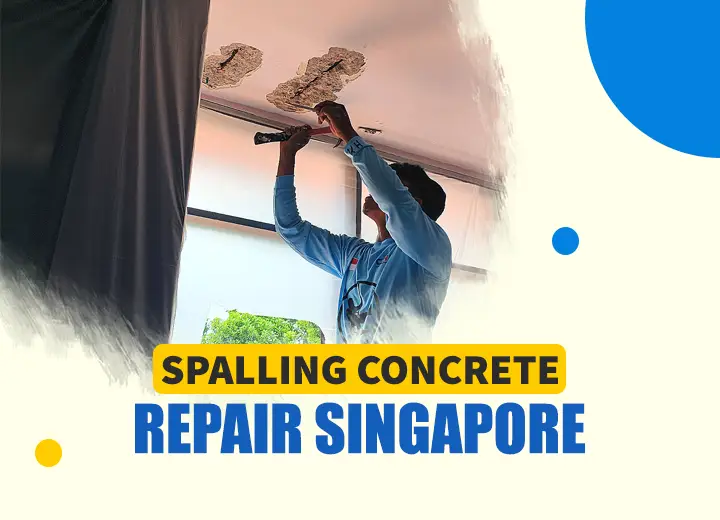
Spalling concrete (surface delamination or concrete flaking) is a critical structural issue affecting buildings, driveways, car park decks, and pavements across Singapore. The outer surface layer begins to chip, flake, or peel away, exposing the internal concrete matrix and embedded steel reinforcement beneath. Without timely professional attention, this deterioration accelerates and directly threatens structural integrity. This comprehensive guide covers everything about spalling concrete, including its root causes, early warning signs, suitable repair materials, step-by-step repair methods, and proven long-term prevention strategies. Whether you manage a residential or commercial property in Singapore, proactively addressing spalling concrete early saves significant time, money, and further structural damage.
What Is Spalling Concrete?
Spalling concrete describes the chipping, flaking, or peeling of the outer concrete surface layer from a structure. Concrete spalling occurs when the outer surface layer chips, flakes, or peels away from the structure. This form of deterioration exposes the internal concrete matrix and embedded steel reinforcement beneath. Engineers across Singapore treat this condition as a critical structural maintenance and safety concern.
Concrete spalling commonly affects car park slabs, building facades, driveways, and structural columns. Surface damage such as pitting and scaling can progress rapidly into deep concrete failure. Prompt detection and repair of spalled areas prevents costly structural restoration and ensures long-term building safety.
Singapore’s high humidity, salt air, and tropical heat accelerate this concrete degradation significantly. What begins as minor surface pitting or crazing can progress quickly to deep structural failure. Identify and repair spalling concrete early to prevent further concrete deterioration and building damage.
Is It Worth Repairing Spalling Concrete?
Yes, repairing spalling concrete is absolutely worth it and saves far more than full slab replacement.
Addressing spalled concrete early stops further deterioration and protects embedded steel reinforcement from rust and corrosion. Repair mortars, epoxy fillers, and concrete patching compounds restore structural strength quickly. Ignoring spalling allows surface damage to penetrate deep into the slab and compromise load-bearing capacity.
Repair costs for minor spalling in Singapore remain significantly lower than full structural replacement. Professional contractors use polymer-modified mortars and fibre-reinforced compounds to extend the service life of damaged structures. Acting promptly on early-stage surface crumbling prevents extensive and expensive civil engineering works later on.
Is Concrete Spalling Dangerous?
Yes, concrete spalling is dangerous and poses serious safety risks to occupants when left unrepaired. Falling concrete fragments from spalled ceilings, columns, or overhead structures create significant injury risks. In high-traffic areas such as car parks, walkways, and public buildings, spalled surfaces become genuine hazards. Singapore’s Building and Construction Authority (BCA) requires property owners to maintain safe structural conditions at all times.
Deep spalling exposes reinforcement steel to moisture and oxygen, accelerating corrosion and reducing structural load capacity. Over time, corroding rebar expands within the concrete, causing further cracking and delamination. This progressive structural failure can ultimately compromise the safety of the entire building without professional intervention.
What Are the Differences Between Concrete Spalling and Scaling?
Concrete spalling and concrete scaling are two different types of surface deterioration. Spalling causes deep chunks, concrete flaking, and rebar exposure, while scaling peels off thin surface sheets. Rebar corrosion and water ingress drive spalling. Freeze-thaw cycles and de-icing salt attack cause concrete scaling. Spalling poses a high structural risk. Scaling stays cosmetic at early stages.
| Feature | Concrete Spalling | Concrete Scaling |
|---|---|---|
| Definition | Chipping or breaking of thick concrete layers | Surface flaking of thin, shallow concrete layers |
| Depth | Deep, often reaching reinforcement steel | Shallow, confined to the surface level only |
| Cause | Corrosion, impact, or insufficient concrete cover | Chemical attack, salt exposure, or poor curing |
| Visual Appearance | Large chunks or fragments detaching from surface | Thin film or surface layer gradually peeling off |
| Structural Risk | High, exposes and endangers embedded steel | Moderate, progressively weakens the surface layer |
| Common Location | Columns, beams, car park decks, and soffits | Driveways, pavements, and exposed floor surfaces |
| Repair Approach | Concrete patching, epoxy injection, FRP wrapping | Concrete resurfacer or protective coating application |
| Urgency | Requires immediate professional structural attention | Treatable early with surface sealers or coatings |
What Are the Differences Between Crack Wall and Spalling Concrete?
Crack wall and spalling concrete are two distinct types of concrete surface damage. A crack wall forms fracture lines through the concrete due to structural movement, shrinkage, or overloading. Spalling concrete causes chunks, flaking, and surface delamination driven by water ingress and rebar corrosion. Cracks need injection or grouting. Spalling needs patch mortar, bonding agent, and a protective waterproofing sealer.
| Feature | Crack Wall | Spalling Concrete |
|---|---|---|
| Definition | Linear fractures forming through the wall surface | Chipping, flaking, or breaking away of surface material |
| Pattern | Linear, diagonal, or irregular crack formations | Irregular surface loss with exposed internal layers |
| Primary Cause | Settlement, thermal movement, or structural overload | Corrosion, water ingress, or poor concrete mix design |
| Depth | Ranges from hairline to full through-wall cracks | Typically involves visible loss of surface material |
| Structural Implication | May indicate foundation or excessive load issues | Indicates cover zone deterioration and rebar exposure |
| Moisture Risk | Allows water penetration along crack paths | Allows direct water ingress into the concrete body |
| Typical Repair | Crack injection, sealant filling, or epoxy grouting | Concrete patching, resurfacing, or FRP composite wrapping |
| Location | Walls, slabs, beams, or structural columns | Car park decks, facades, columns, and floor surfaces |
Why Should You Repair Spalling Concrete?
Repairing spalling concrete protects structural integrity and prevents far more expensive damage in the future. Spalled concrete surfaces expose embedded reinforcement steel to moisture, oxygen, and chemical agents. Timely repair using polymer-modified mortars and protective sealers stops deterioration at the surface level. Property owners in Singapore who address spalling early avoid lengthy and costly structural rehabilitation works later on.
- Protects Structural Integrity
Repairing spalled concrete restores load-bearing capacity, protects embedded reinforcement, and prevents further structural degradation in affected buildings.
- Prevents Reinforcement Corrosion
Exposed rebar corrodes rapidly when moisture and oxygen reach it through spalled surfaces, significantly weakening the entire concrete structure.
- Prevents Accidents
Falling concrete fragments and uneven spalled surfaces create serious trip and injury hazards for building occupants and nearby pedestrians.
- Prevention of Water Infiltration
Spalled surfaces allow water ingress directly into the concrete body, accelerating internal deterioration and damaging the embedded steel reinforcement.
- Prevents Larger Structural Repairs Later
Addressing minor spalling early avoids deep structural failure, saving significant costs and preventing major civil engineering interventions down the line.
What Is the Downside of Sealing Concrete?
Sealing concrete has drawbacks including moisture trapping, periodic reapplication requirements, and potential chemical exposure risks. Concrete sealers protect surfaces from water ingress and chemical attack, but they also introduce certain limitations. Improper sealer selection or application can trap moisture beneath the surface layer. This leads to delamination, bubbling, and accelerated concrete deterioration in Singapore’s consistently humid tropical climate.
Solvent-based sealers release volatile organic compounds (VOCs) that irritate the respiratory system. These toxic fumes also damage the skin and eyes during and after application. Always apply concrete sealers in well-ventilated areas or fully open outdoor spaces. Wear personal protective equipment (PPE) such as gloves, goggles, and a respirator mask. Water-based acrylic sealers produce far fewer VOCs and are a safer alternative choice.
The key downsides of sealing concrete are outlined in this graphic.
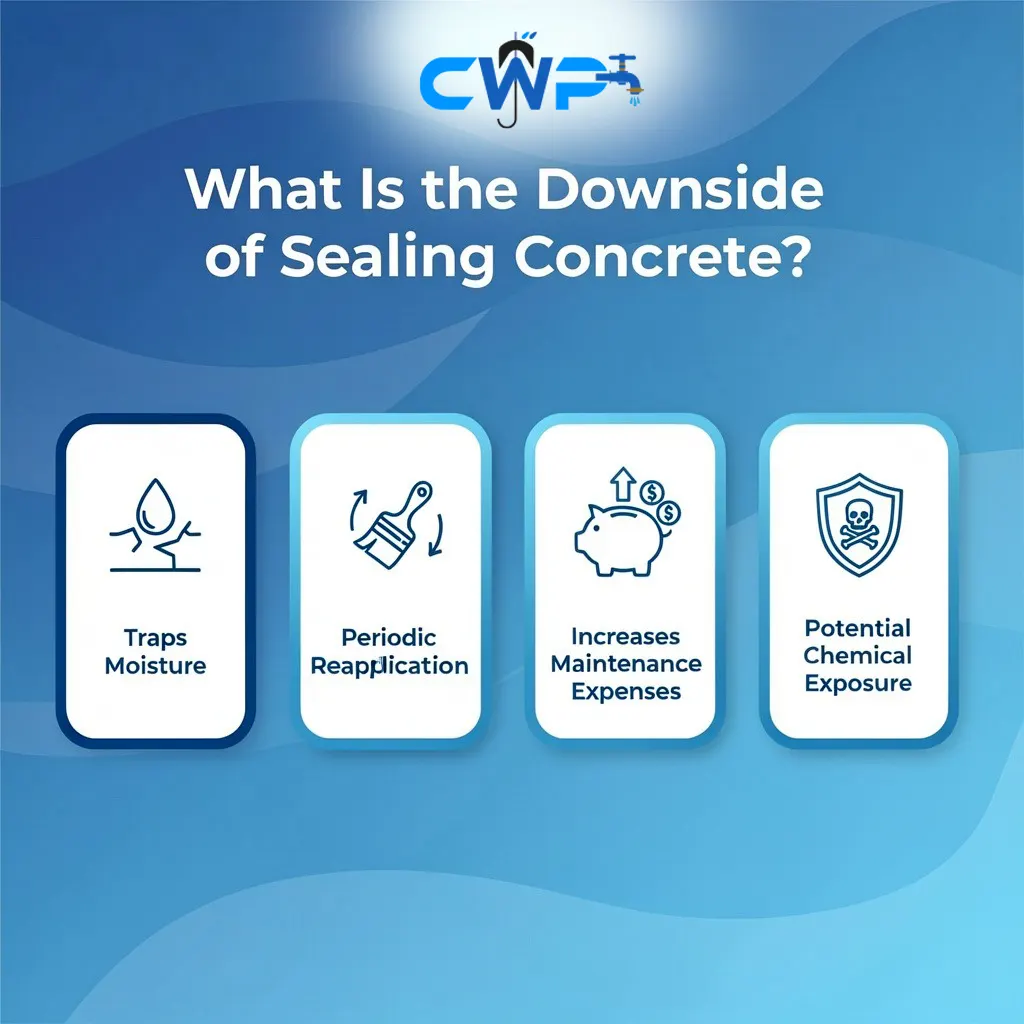
- Traps Moisture: A poorly applied or incorrect sealer traps existing moisture beneath the surface, causing concrete to blister, delaminate, and deteriorate more rapidly.
- Periodic Reapplication: Concrete sealers wear down over time and require regular reapplication every two to five years to maintain effective surface protection.
- Increases Maintenance Expenses: Ongoing sealer reapplication, surface preparation, and professional application labour significantly increase long-term property maintenance expenses for building owners.
- Potential Chemical Exposure: Solvent-based concrete sealers release volatile organic compounds (VOCs) during application, posing health risks to workers and occupants in enclosed spaces.
What Are the Main Causes of Spalling Concrete?
Spalling concrete results from corrosion, water ingress, poor mix design, and inadequate reinforcement cover depth. Concrete deterioration begins when the protective cover zone breaks down due to moisture, chemicals, or physical stress. Steel reinforcement exposed to oxygen and water corrodes rapidly, expanding within the concrete and forcing the outer layer to crack and spall. Singapore’s tropical climate, with its high humidity and heavy rainfall, significantly accelerates this process.
- Corrosion of Steel Reinforcement: Corroding steel reinforcement expands within the concrete, generating internal pressure that forces the outer surface layer to crack and spall.
- Continuous Water Exposure: Persistent water ingress through the concrete surface carries chlorides and carbonates deep into the structure, accelerating corrosion of embedded steel reinforcement.
- Poor Concrete Mix: A poorly proportioned concrete mix with a high water-cement ratio reduces density and durability, making the surface more vulnerable to cracking and spalling.
- Inadequate Concrete Cover: Insufficient concrete cover over steel reinforcement allows moisture to reach the rebar quickly, causing rapid corrosion and eventual surface spalling.
- Chemical Exposure: Contact with chlorides, sulphates, and acid-based compounds deteriorates the cement paste, weakening the surface layer and triggering progressive concrete spalling.
- Improper Curing or Rushed Construction: Insufficient curing time reduces concrete strength and surface hardness, making it highly susceptible to early-age cracking, scaling, and surface spalling.
- Ageing and Weathering: Long-term exposure to Singapore’s tropical heat, heavy rainfall, and high humidity gradually breaks down the cement matrix, leading to surface spalling over time.
What Materials Are Used for Spalling Concrete Repair?
Professionals use high-performance materials to repair spalling concrete, including patching mortars, epoxy resins, and fibre-reinforced polymers. Selecting the correct repair material depends on the depth, location, and severity of the spalling damage. Shallow surface spalling responds well to cementitious repair mortars and concrete resurfacers. Deep spalling involving exposed reinforcement requires epoxy resins, fibre-reinforced polymers, or hydraulic cement for full structural restoration.
1. Applied Concrete Patch or Repair Mortar
Apply polymer-modified repair mortar to fill and restore spalled and delaminated surface areas. Cementitious patch mortar fills pits, concrete chips, and delaminated areas in walls or ceilings. Polymer-modified mortar offers superior adhesion, flexibility, and durability compared to plain cement mortar. Press the repair compound firmly into the spalled zone to eliminate all air voids. Smooth it flush with the surrounding undamaged concrete surface using a trowel. This repair mortar suits walls, floors, overhead ceilings, and columns across Singapore buildings.
2. Used Epoxy Resin
Use epoxy resin to repair deep, structural, and load-bearing spalling damage effectively. Epoxy mortar is a two-part structural adhesive offering very high compressive bond strength. It bonds firmly to the existing concrete substrate and fills deep structural voids completely. Epoxy is water-resistant and chemical-resistant, making it ideal for Singapore’s wet climate. Mix the resin component and hardener strictly to the manufacturer’s specified ratio. Work within the product’s pot life before the epoxy mixture begins to cure and harden.
3. Ideal Polyurethane Sealant
Polyurethane sealant is ideal for sealing repaired concrete against water ingress and moisture. PU sealant creates a flexible, waterproof barrier that bonds well to cementitious substrates. Its high elongation factor allows the sealant to flex with thermal movement and expansion. This flexibility prevents re-cracking in repaired, patched, and sealed concrete areas. One-part and two-part polyurethane sealants are both widely available from Singapore suppliers. Choose a UV-resistant formula for all outdoor, exposed, and directly sunlit concrete surfaces.
4. Use Cement-based Repair Products
Cement-based repair products suit most standard concrete spalling and surface delamination repair jobs. Cementitious repair mortars bond well to existing concrete substrates and are easy to apply. They suit indoor and outdoor repairs on walls, floor slabs, beams, and overhead ceilings. Shrinkage-resistant and rapid-set cement variants reduce post-application cracking and surface deterioration. These products are widely available at Singapore hardware stores and building material suppliers. Use them alongside an SBR or acrylic bonding agent for the best adhesion and durability.
5. Use Hydraulic Cement
Use hydraulic cement to repair actively leaking and wet concrete surfaces immediately. Unlike standard cement mortar, hydraulic cement sets and hardens even under active water flow. It plugs active water leaks in basement walls, retaining structures, and water tanks. Mix it quickly and press it firmly into the leak source before it sets hard. The working time is very short, so work fast and with confidence. Use hydraulic cement to stop water infiltration before applying any patch mortar.
6. Apply Fibre-Reinforced Polymer (FRP)
Apply fibre-reinforced polymer (FRP) to strengthen and restore large structural spalling areas. Carbon FRP (CFRP) and glass FRP (GFRP) are the two most common structural reinforcement types. FRP sheets laminate to the substrate using a structural epoxy adhesive and primer system. They are lightweight, extremely strong, corrosion-free, and highly durable in tropical conditions. FRP structural strengthening suits beams, columns, and slabs with deep or widespread spalling. Specialist BCA-registered contractors apply FRP as part of full structural rehabilitation works.
7. Use Concrete Resurfacer
Use a concrete resurfacer to restore smooth, sound surfaces over light to moderate spalling. Self-levelling resurfacers flow across the damaged substrate and fill surface pits and chips. Polymer-modified overlays and micro-toppings restore a clean, even, and durable surface finish. Pour and spread the resurfacer evenly across the damaged area using a squeegee or trowel. This compound suits floors, driveways, car park decks, and large flat surface areas. Always apply a bonding primer to the prepared substrate before pouring any resurfacing compound.
8. Apply Bonding Agents
Apply a bonding agent so all repair materials adhere firmly to the existing concrete. A bonding primer creates a strong chemical interface between old and new cementitious materials. Without a bonding agent, patch mortar, epoxy, and resurfacer will delaminate and peel away. SBR (styrene-butadiene rubber) bonding agents and acrylic primers are the most commonly used types. Brush or roll the bonding agent onto the entire prepared substrate and exposed edges. Skipping the bonding agent is the most common cause of early concrete repair failure.
How Do You Fix Spalling Concrete?
You fix spalling concrete by assessing the damage, removing loose material, treating the rebar, and applying the correct repair compound.
Spalling concrete repair follows a structured, step-by-step process to restore structural integrity and surface durability. Proper assessment, thorough preparation, and correct selection of repair materials determine the overall success of the repair. Professionals in Singapore follow BCA guidelines and industry standards to ensure lasting, high-quality concrete restoration outcomes.
This graphic explains some of the best methods for repairing spalling concrete.
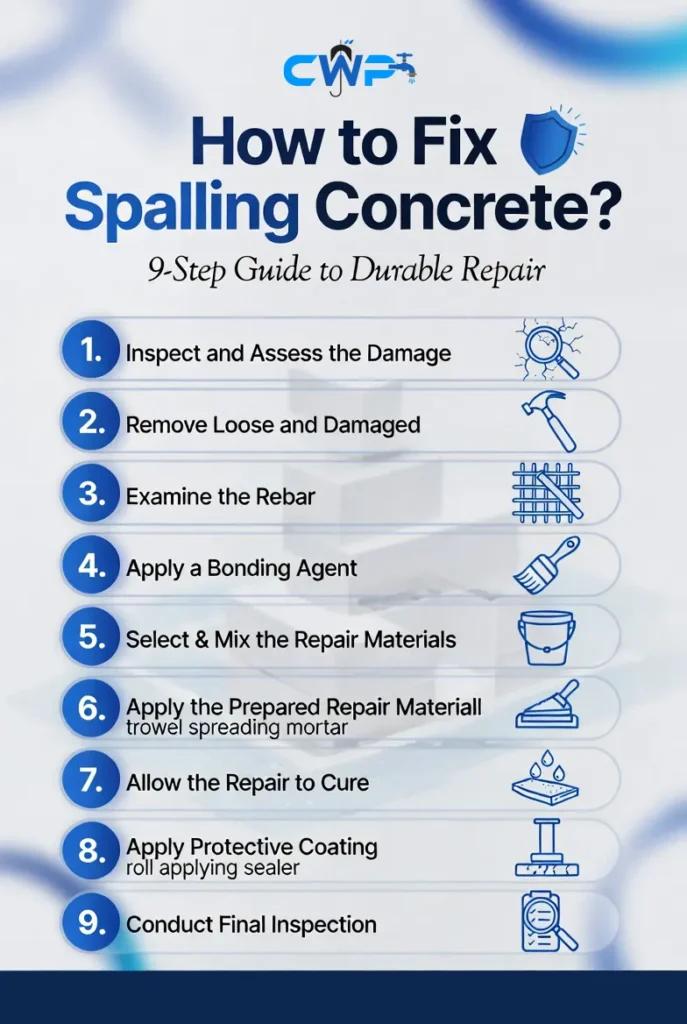
Step 1: Inspect and Assess the Damage
Inspect the spalled area thoroughly to assess the depth, extent, and severity of surface and structural concrete damage.
Step 2: Remove Loose and Damaged
Use a chisel, hammer, or mechanical scarifier to remove all loose, delaminated, and structurally compromised concrete from the spalled area.
Step 3: Examine the Rebar
Inspect exposed steel reinforcement for signs of corrosion, section loss, and surface rust, then treat with a suitable anti-corrosion primer.
Step 4: Apply a Bonding Agent
Apply a suitable bonding agent to the prepared concrete substrate to maximise adhesion between the existing surface and the new repair material.
Step 5: Select and Mix the Repair Materials
Select the appropriate repair compound based on damage depth and location, then mix it precisely according to the manufacturer’s specifications.
Step 6: Apply the Prepared Repair Material
Trowel or pour the mixed repair compound into the prepared area, ensuring full substrate contact and adequate compaction throughout the repair.
Step 7: Allow the Repair to Cure
Allow the repair compound to cure fully according to the manufacturer’s recommended curing period and ambient temperature conditions on site.
Step 8: Apply Protective Coating
Apply a high-quality waterproof sealer or protective coating over the cured repair to prevent future moisture ingress and surface deterioration.
Step 9: Conduct Final Inspection
Inspect the completed repair for surface defects, delamination, or voids, and confirm that the restored area meets structural and finish requirements.
How Do You Protect Against Spalling?
You protect concrete against spalling by using quality materials, proper curing, protective sealers, and regular professional maintenance. Preventing concrete spalling requires a proactive approach that addresses both design decisions and ongoing maintenance practices. High-quality concrete mixes, adequate reinforcement cover, and effective drainage systems significantly reduce the risk of surface deterioration. In Singapore’s humid tropical environment, regular inspection and timely protective treatments extend concrete service life considerably.
This guide shows some of the best ways to protect against spalling.
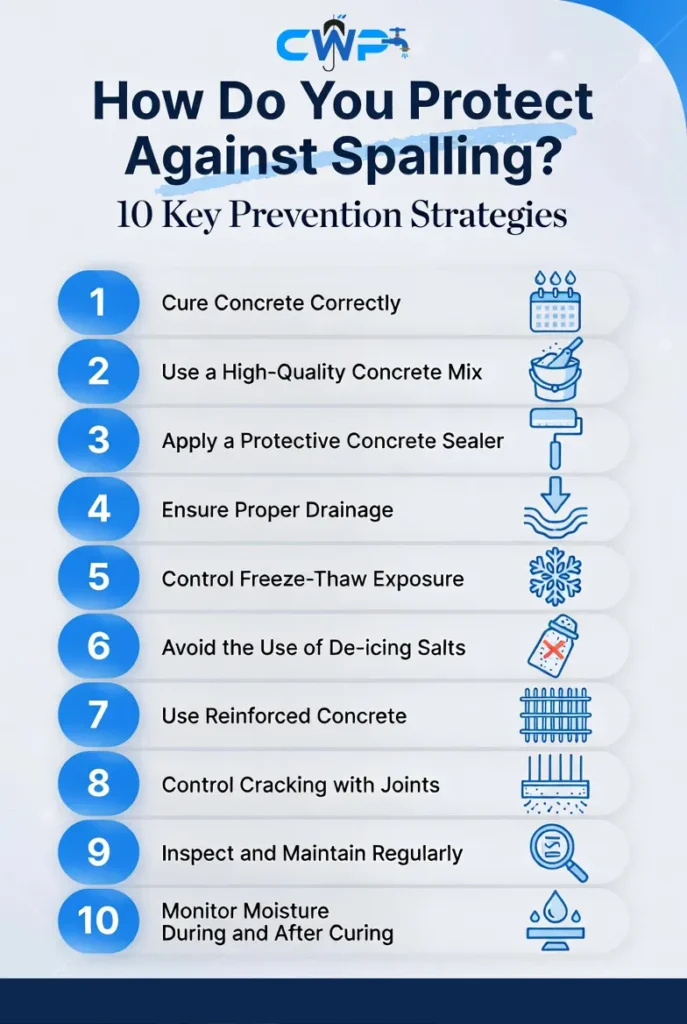
Process 1: Cure Concrete Correctly
Cure concrete correctly so it develops full compressive strength and resists surface spalling. Concrete reaches full strength only with sustained moist curing after placement. Rushed or premature curing produces a brittle, porous surface prone to concrete chipping. Cover fresh concrete with wet hessian, polythene sheeting, or a spray-applied curing compound. Maintain surface moisture for at least seven days after placing and finishing the concrete. Good curing practice prevents the shrinkage cracks that become water ingress pathways later.
Process 2: Use a High-Quality Concrete Mix
Use a high-quality, BCA-certified concrete mix to prevent spalling and surface deterioration. A low water-cement ratio produces dense, low-permeability concrete with high compressive strength. Well-graded aggregates and approved admixtures improve workability without increasing water content. Air-entrained concrete provides extra resistance to surface scaling in some exposure conditions. Buy certified ready-mix concrete from BCA-approved suppliers for all structural elements. A strong, dense mix is your first and most durable defence against water ingress.
Process 3: Apply a Protective Concrete Sealer
Apply a protective waterproofing sealer to block water ingress and prevent surface delamination. Penetrating sealers absorb into pores and block capillary moisture rise from within the substrate. Film-forming sealers coat the surface externally and repel water, chlorides, and chemical attack. Apply the sealer only after the concrete has cured fully to its design strength. Use the water bead test first – if water absorbs, the concrete needs sealing immediately. Reapply the waterproofing sealer every two to three years to maintain its protective effectiveness.
Process 4: Ensure Proper Drainage
Ensure proper surface drainage to prevent water ponding and moisture ingress into concrete. Standing water accelerates carbonation, chloride penetration, and progressive surface delamination. Design drainage channels and falls with adequate gradient to direct all surface runoff away. Keep gutters, downpipes, drainage outlets, and roof drains clear and fully functional. Flat roofs, terraces, and planter boxes all need adequate drainage outlets to prevent ponding. Inspect all drainage systems regularly, especially during Singapore’s heavy monsoon rainfall season.
Process 5: Control Freeze-Thaw Exposure
Control freeze-thaw exposure to prevent concrete scaling and surface cracking in cold climates. Freeze-thaw cycles force water to expand inside pores and crack the concrete from within. Singapore has no frost, but this guidance applies directly to overseas project specifications. Air-entrained concrete provides microscopic air voids that absorb the pressure of ice expansion. These air voids prevent the internal pressure that causes surface scaling and concrete deterioration. Specify frost-resistant, air-entrained concrete with a low water-cement ratio for all cold-climate projects.
Process 6: Avoid the Use of De-icing Salts
Avoid de-icing salts on concrete to prevent chloride attack and accelerated surface spalling. Sodium chloride and calcium chloride de-icing salts accelerate rebar corrosion significantly. Chloride ions penetrate the concrete cover and trigger electrochemical oxidation of the steel bars. Salt also draws moisture infiltration into the pore structure and raises internal hydrostatic pressure. This pressure causes surface scaling, concrete flaking, and progressive structural delamination over time. Rinse coastal concrete regularly in Singapore to remove accumulated chloride salt deposits.
Process 7: Use Reinforced Concrete with Steel or Fibres
Use reinforced concrete with steel rebar or fibre reinforcement to prevent cracking and spalling. Steel reinforcement bars provide tensile and flexural strength that plain, unreinforced concrete cannot offer. Rebar controls crack propagation and prevents uncontrolled surface delamination across structural elements. Polypropylene fibres and steel fibres control shrinkage cracking and concrete chipping in floor slabs. Fibre-reinforced concrete distributes structural loads more evenly and reduces surface deterioration risk. Specify adequate cover depth to protect all reinforcement bars from moisture and carbonation.
Process 8: Control Cracking with Joints
Cut control joints into concrete to manage cracking and prevent uncontrolled surface spalling. Concrete expands and contracts with thermal cycling, moisture changes, and structural loading. Without planned movement joints, this thermal stress causes random and uncontrolled cracking. Contraction joints and control joints guide cracking to planned, non-critical locations in the slab. Expansion joints accommodate larger thermal movement in long-span slabs, pavements, and car park decks. Seal all joints with a polyurethane sealant regularly to prevent water ingress into the joint.
Process 9: Inspect and Maintain Regularly
Inspect and maintain concrete regularly to catch and repair spalling and surface deterioration early. Schedule a full condition assessment and structural survey at least once every two years. Look for hairline cracks, surface pitting, rust staining, concrete chipping, and surface delamination. Use the hammer tap test to identify all hollow, delaminated, and unsound concrete areas. Repair all minor concrete flaking and surface pitting immediately before it advances to structural spalling. Proactive maintenance and early intervention are always cheaper than reactive structural rehabilitation.
Process 10: Monitor Moisture During and After Curing
Monitor moisture levels during and after curing to achieve full concrete design strength. Apply curing compounds immediately after placing concrete to retain surface moisture and hydration. These waterproofing compounds seal the surface and slow moisture evaporation during the curing period. Avoid curing in direct sunlight or strong wind without shade protection and wind barriers. Monitor ambient temperature and relative humidity throughout curing using a calibrated moisture meter. Proper moisture control during curing prevents shrinkage cracking and early surface deterioration.
How Do You Know If Concrete Needs to Be Sealed?
Concrete needs sealing when the water bead test shows rapid surface water absorption. Perform the water bead test by dropping water directly onto the concrete substrate. If the water absorbs within a few minutes, the waterproofing sealer has failed completely. If water beads and rolls off the surface, the existing protective film-forming sealer still works. Also check for surface staining, discolouration, surface dustiness, and progressive concrete pitting. Porous, dull, or stain-prone concrete always needs a fresh penetrating or film-forming sealer.
Look for surface cracking, concrete flaking, and discolouration as signs of sealer breakdown. When these signs appear, apply a best waterproofing sealant to restore full surface protection and block further moisture ingress. Concrete that absorbs oil, water, and chemicals readily needs immediate resealing and waterproofing. Unsealed concrete stains easily and deteriorates through progressive surface delamination and pitting. Reseal all outdoor concrete in Singapore every two to three years as standard maintenance practice. Reseal sooner if heavy traffic wear, chemical exposure, or visible staining is present.
What Are the BCA-Listed Contractors for Spalling Concrete Repair?
Singapore’s BCA maintains an official register of licensed contractors for structural concrete repair. Always use a BCA-registered firm for all spalling remediation and waterproofing work. BCA registration confirms the firm meets Singapore’s building safety and structural repair standards. Always verify a contractor’s active licence status before you engage them for any work.
1. Classic Waterproofing and Plumbing Pte Ltd
Classic Waterproofing and Plumbing Pte Ltd (CWP) is a Singapore-registered company specialising in professional waterproofing solutions. They hold all required BCA licences and certifications for waterproofing work. With decades of industry understanding and technical expertise, they provide systematic waterproofing services designed to prevent structural deterioration, water intrusion, and costly long-term damage. Their services cover spalling concrete repair, plumbing, rope access, and facade remediation across residential, commercial, and industrial buildings throughout Singapore. CWP offers one to ten years of warranty on their waterproofing services, depending on the surface area and quality of waterproofing membranes used.
2. Heng Seng Engineering and Contracting Pte Ltd
Heng Seng Engineering and Contracting Pte Ltd is a BCA-registered building contractor based in Singapore. The firm provides general building works, structural concrete repair, and construction-related services across the residential and commercial sectors. They serve HDB, condominium, and institutional clients across Singapore. Their work covers concrete remediation, surface restoration, and structural maintenance in line with BCA standards and Singapore building safety requirements. Building owners are advised to verify their active BCA licence status before engagement.
3. Unison Construction Pte Ltd
Unison Construction Pte Ltd was incorporated on 2 July 2009 in Singapore. The company’s principal activity is general contractors for building construction including major upgrading works. They specialise in general building works across Singapore’s residential, commercial, and institutional sectors. Registered with BCA, the firm undertakes structural repair, major upgrading, and building restoration projects. Their work aligns with BCA workmanship and safety standards for all construction and concrete remediation works in Singapore.
4. APlus Engineering Pte Ltd
APlus Engineering Pte Ltd is a Singapore-based engineering and construction services firm registered with the Building and Construction Authority. The company provides building construction, civil works, plant maintenance, equipment installation, and structural repair services. They operate across Singapore’s commercial, residential, and industrial sectors. Their technical team carries out concrete remediation and structural maintenance works in compliance with BCA licensing requirements and Singapore building safety regulations. Building owners should verify their current BCA registration and workhead grading before engaging them.
5. Goldhill Engineering Pte Ltd
Goldhill Engineering Pte Ltd is a Singapore-registered engineering contractor providing structural and civil engineering services. The firm undertakes concrete repair, building works, structural remediation, and maintenance services for residential, commercial, and institutional clients. Their work scope covers spalling concrete repair, waterproofing, and general building construction works across Singapore. They operate in compliance with BCA standards and Singapore’s structural safety requirements. Always verify their active BCA licence and workhead grading before engaging the firm for any structural repair work.
6. Shimizu Corporation (Singapore Branch)
Shimizu opened an office in Singapore in 1973. Their very first project was the construction of a shipyard facility for Mitsubishi Heavy Industries, Ltd. Shimizu Corporation has more than 200 years of experience in the Japanese construction domain and has won over the Singaporean market through a local ethos and commitment to delivery.Their Singapore portfolio spans office, medical, educational, residential, transportation, retail, and industrial sectors.They have built landmark structures including Ngee Ann City, Republic Plaza, and the National Heart Centre. Their services cover contracting for building, civil engineering, and other construction works, as well as investigation, planning, research, design, supervision, engineering, management, and consulting in connection with construction and civil works.
7. Penta-Ocean Construction Co Ltd
Penta-Ocean is a major Japanese construction firm specialising in marine works and land reclamation, listed on the Tokyo Stock Exchange. Over the past 60 years since 1964, Penta-Ocean has participated in several large-scale projects in Singapore, from marine civil engineering works such as reclamation and construction of container terminals, to land-based civil engineering works such as subways and highways, to construction of landmark commercial facilities and large-scale hospitals. Their Singapore landmark projects include VivoCity, the ArtScience Museum, the Esplanade, and Marina Bay reclamation works. Their Singapore branch is a BCA-registered A1-grade contractor, holding ISO 9001, ISO 14001, and OHSAS 18001 certifications.
Request at least three quotations from BCA-listed contractors before making any decision. Compare experience, project references, repair warranties, certifications, and BCA licence grade carefully. A well-chosen BCA-registered contractor delivers durable concrete remediation that meets all standards.
Frequently Asked Questions (FAQ’s)
Yes, spalling occurs more frequently in older concrete structures. Ageing reduces protective cover quality, deepens carbonation, and weakens resistance to moisture ingress and chemical attack over time.
Yes, untreated spalling concrete worsens progressively. Moisture, oxygen, and chemicals continue to penetrate the exposed surface, accelerating reinforcement corrosion, delamination, and structural deterioration over time.
Sealing concrete significantly reduces the risk of spalling by blocking water ingress and chloride penetration. It does not eliminate the risk entirely but extends the service life of concrete surfaces considerably.
Plastering over spalled concrete without proper surface preparation and rebar treatment offers only temporary cosmetic improvement. Professionals recommend full spalling repair and protective coating before any finish plaster application.
The first signs of spalling include surface pitting, hairline cracks, flaking render or paint, exposed aggregate, and rust staining on concrete near embedded steel reinforcement.
Yes, new concrete can go over old concrete using a bonding agent and proper surface preparation. The existing substrate must be structurally sound, clean, and completely free of loose material.
Spalling refers to the surface deterioration of concrete structures in construction. Spallation is a broader scientific term describing fragmentation of materials under high-velocity impact or internal stress wave conditions.
In Singapore, building owners and Management Corporation Strata Titles (MCSTs) hold responsibility for repairing spalling concrete under the Building Maintenance and Strata Management Act and BCA structural maintenance requirements.