
BCA waterproofing requirements protect structures from water damage, ensure occupant safety, and maintain long-term building quality across the country.
These regulations protect structures from water protection ensure occupant safety, and maintain long-term building quality across the country. Waterproofing might not be the most glamorous aspect of construction, but it is one of the most critical. A single failure in a building’s waterproofing system can lead to costly repairs , structural deterioration, and serious health risks. For property developers, contractors, and building owners in Singapore, understanding and complying with BCA waterproofing requirements is not optional. It is a legal and professional obligation. This guide covers everything you need to know: why these requirements matter, which areas they apply to, what waterproofing materials are approved, how inspections work, and what you can do to stay compliant.
Why Are BCA Waterproofing Requirements Important in Singapore Buildings?
BCA waterproofing requirements are vital to protect buildings from water damage and maintain structural integrity. They ensure long-lasting, safe, and healthy environments for occupants. With Singapore’s heavy rainfall and humidity, these standards prevent leaks, corrosion, and mould, reducing costly repairs and preserving the building’s value over time.
This infographic shows important of BCA waterproofing requirements in Singapore.
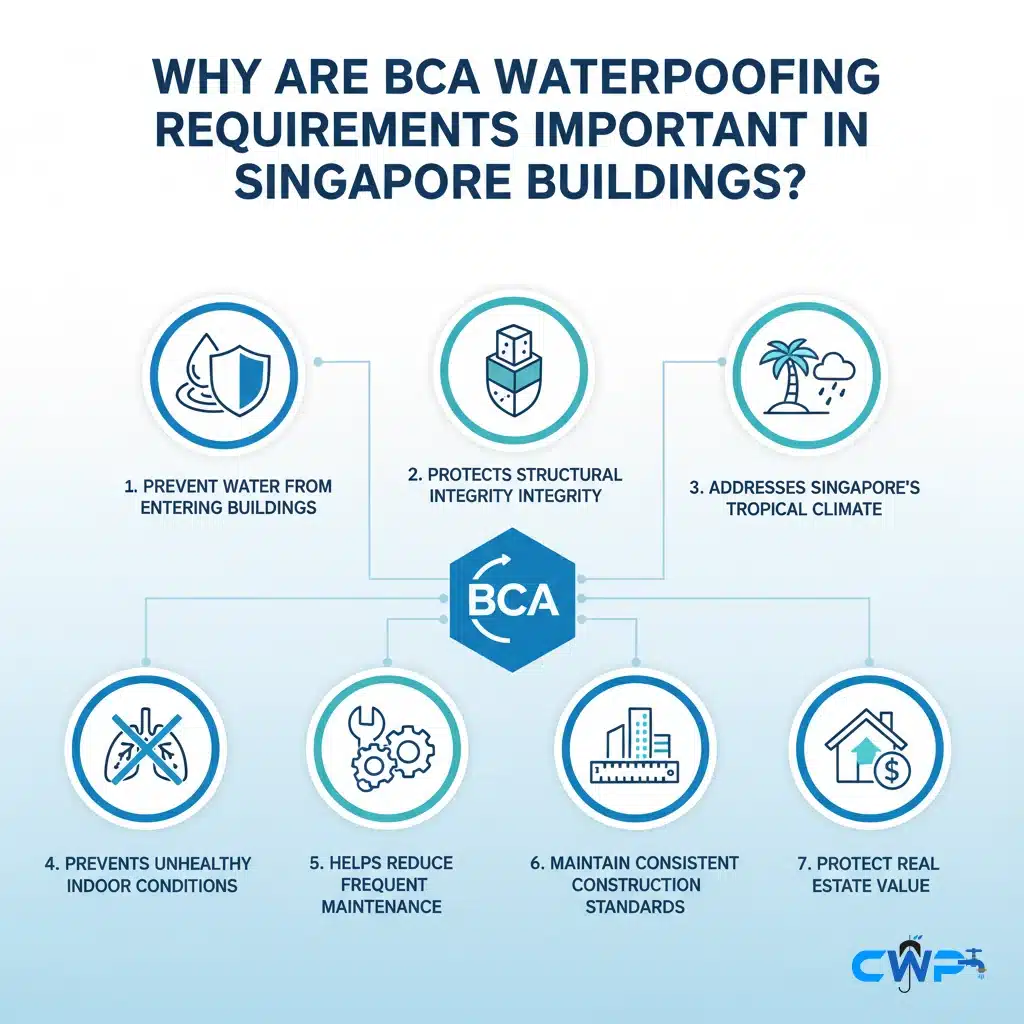
1. Prevent Water From Entering Buildings
Singapore receives over 2,300 mm of rainfall each year. Without proper waterproofing, water penetrates walls, floors, and ceilings, causing immediate and long-term damage. BCA requirements create a consistent baseline that every building must meet.
2. Protects Structural Integrity
Water is one of the most destructive forces acting on a building. When moisture infiltrates concrete and steel reinforcements, it accelerates corrosion and weakens the entire structure. BCA waterproofing standards help preserve a building’s load-bearing capacity over its full lifespan.
3. Addresses Singapore’s Tropical Climate
Singapore’s high humidity and frequent heavy rain create a unique set of waterproofing challenges. The BCA’s guidelines are specifically designed with this tropical environment and Singapore climate in mind, ensuring that materials and methods are fit for local conditions. These requirements help buildings withstand the harsh weather conditions in Singapore.
A study published on Journal of Applied Meteorology and Climatology entitled “Observed Rainfall Trends over Singapore and the Maritime Continent from the Perspective of Regional-Scale Weather Regimes”, showed that using data from 22 meteorological stations (1982–2011), the study analyzed 5-day antecedent rainfall across 3 decades. Rainfall increased from 420.5 mm (1987) to 592.9 mm (2006). Higher rainfall in north/northeast Singapore correlated with more slope failures, especially in Decade 3 (2002–2011).
4. Prevents Unhealthy Indoor Conditions
Damp buildings breed mould and fungus. Prolonged exposure to mould spores triggers respiratory problems and other health issues. Proper waterproofing keeps indoor environments dry, clean, and safe for occupants.
5. Helps Reduce Frequent Maintenance
Buildings that meet BCA waterproofing standards require far less reactive maintenance. Owners spend less time and money fixing leaks and water damage, and more time managing a well-functioning property.
6. Maintain Consistent Construction Standards
The BCA’s CONQUAS (Construction Quality Assessment System) framework ensures that waterproofing quality is measured and verified consistently across all building types in Singapore from private residential developments to large commercial projects.
7. Protect Real Estate Value
A building with a history of water damage or failed waterproofing loses value quickly. Compliance with BCA requirements protects the long-term market value of a property and builds trust with future buyers or tenants.
What Areas of a Building Must Meet BCA Waterproofing Requirements?
BCA waterproofing requirements apply to key areas like roofs, balconies, bathrooms, and basements. These areas are especially vulnerable to water damage. Proper waterproofing in these zones prevents leaks, mould, and structural damage. It ensures long-term building safety, reducing maintenance costs and preserving the building’s value.
This graphic shows building areas that meet BCA waterproofing requirement in Singapore.
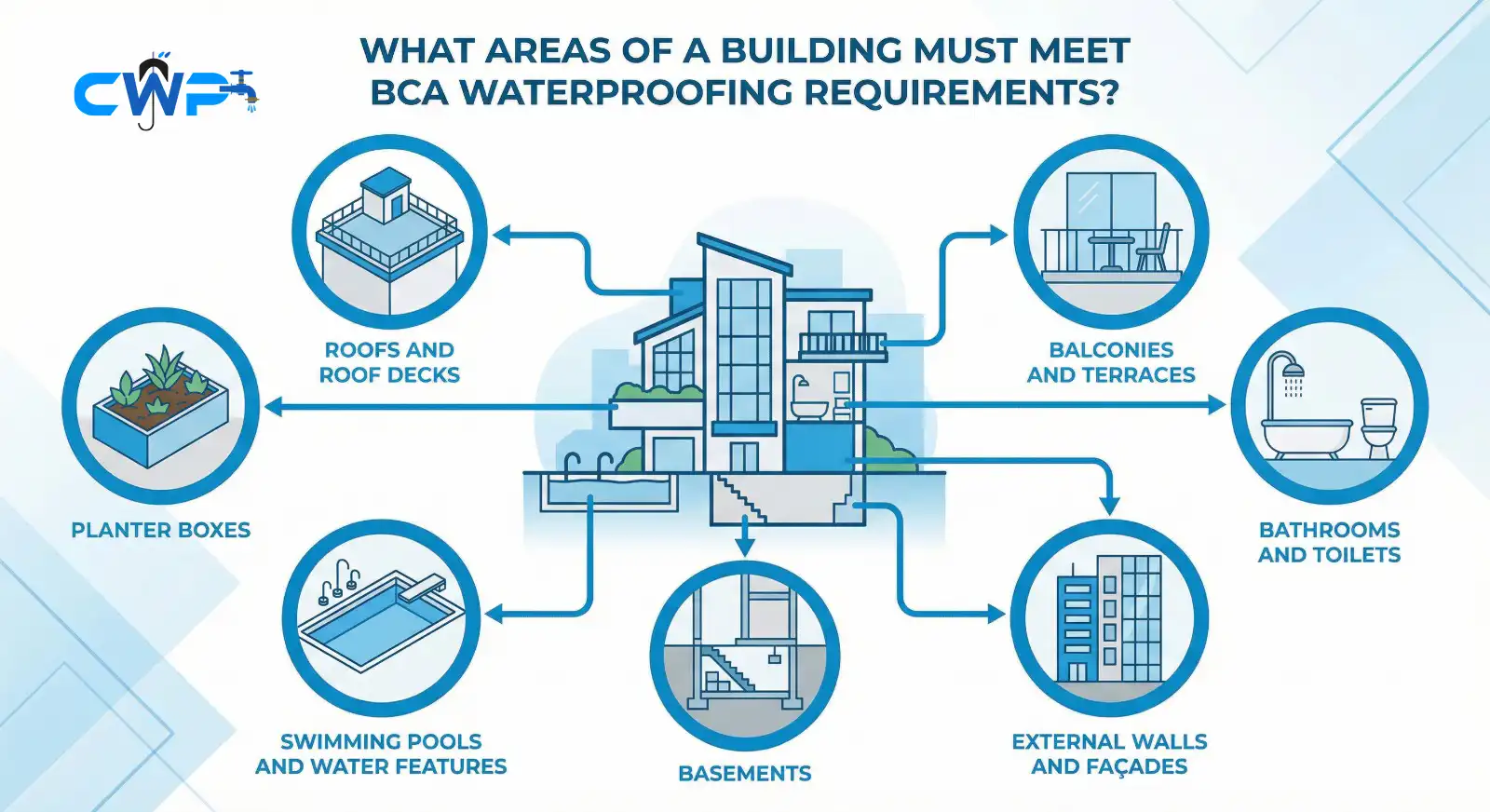
Areas that commonly must meet BCA waterproofing requirements include:
- Roofs and roof decks
- Balconies and terraces
- Bathrooms and toilets
- External walls and façades
- Swimming pools and water features
- Planter boxes
- Basements
1. Roofs and Roof Decks
Flat and low-pitch roofs are particularly vulnerable to water pooling and infiltration. Waterproofing membranes must be applied correctly to prevent leaks from working their way into the building below.
2. Balconies and Terraces
Balconies and terraces are exposed to direct rainfall and require robust waterproofing systems, including upstands and proper drainage details, to prevent water from seeping into adjacent internal spaces.
A research found in the Research Gate entitled “Comparative Study Of Ips & Ppvc Precast System- A Case Study Of Public Housing Buildings Project In Singapore”, showed that In Singapore’s Anchorvale Cove HDB project (10 blocks, 16 stories, 1011 units, 90% precast), balcony slabs were IPS precast horizontal elements (installation via tower crane), unlike PPVC HHS (75% faster install). PPVC cuts manpower 40% structural/70% architectural vs. IPS 10%/30%, slab cycle 6 vs. 12-14 days.
3. Bathrooms and Toilets
Wet areas are among the most tightly regulated zones under BCA standards. Waterproofing must be installed and tested before floor and wall finishes are applied. The BCA’s CONQUAS 2022 framework specifically mandates wet area water-tightness testing for bathrooms and toilets across all building categories.
4. External Walls and Building Façades
External walls face continuous exposure to wind-driven rain. Wall waterproofing, including waterproof render, sealants, and properly designed cladding systems, protects the building envelope from moisture ingress. These measures are essential in preventing water damage and ensuring the long-term durability of the structure.
A study published in the E3S Web of Conferences entitled “A Review of Exterior Waterproofing Technologies in Prefabricated Buildings”, This paper reviews prefabricated building exterior wall waterproofing technologies: waterproof coils, sealants, grouting, coatings, waterproof concrete, and integrated insulation-drainage. It analyzes pros/cons, urging future new materials research and quantitative experimental comparisons to enhance performance.
5. Swimming Pools and Water Features
Suspended swimming pools and water features require zero tolerance for leakage. CONQUAS 2022 standards require no water leakage from these structures, with testing conducted at one location per pool or feature.
6. Planter Boxes
Planter boxes sit above habitable or occupied spaces and must be waterproofed thoroughly to prevent structural harm and water damage to the structure below.
7. Basements
Basements are below ground and face hydrostatic pressure from surrounding soil and groundwater. Waterproofing systems must resist this pressure and remain effective throughout the building’s design life.
What Waterproofing Materials Meet BCA Waterproofing Requirements?
BCA waterproofing requirements are met with materials like cementitious coatings, polyurethane membranes, and bituminous systems. These materials offer excellent protection against water damage.
Waterproofing membranes, flashings, sheet flooring, and sealants, other materials that can meet BCA waterproofing requirements include:
- Cementitious waterproof coatings
- Polyurethane waterproofing membranes
- Bituminous waterproofing membranes
- Crystalline waterproofing compounds
- PVC Waterproofing Membranes
- EPDM membranes
- Acrylic waterproof coatings
- Injection Grouts (PU or Epoxy)
- Waterproof concrete admixtures
- Liquid rubber waterproof coatings
1. Cementitious Waterproofing Coatings
These cement-based coatings are commonly used on internal wet areas, water tanks, and basements. They bond chemically to concrete surfaces and provide a durable, rigid waterproof layer.
A study published on Journal of Building Engineering entitled “Influences of the joint action of sulfate erosion and cementitious capillary crystalline waterproofing materials on the hydration products and properties of cement-based materials: A review” showed that Cementitious capillary crystalline waterproofing materials (CCCW) improve sulfate resistance in cement-based materials by competing for Ca2+. CCCW enhances hydration, heals cracks (0.4–0.5 mm in clean water, 0.3 mm under sulfate erosion), and outperforms sulfate reactions in maintaining material properties.
2. Polyurethane (PU) Liquid Membranes
PU membranes are flexible, seamless, and highly effective on roofs, balconies, and terraces. They accommodate minor structural movement without cracking, making them a popular choice in Singapore’s construction industry.
3. Bituminous Waterproofing Systems
Bituminous systems applied either as torched-on sheets or cold-applied liquids are widely used for roofing and below-ground applications. They offer excellent resistance to water and UV degradation when properly applied.
A study published in the Construction and Building Materials entitled “Evaluation of TDI production waste as a modifier for bituminous waterproofing”, showed that the waste residue from toluene diisocyanate production was surface modified with stearic acid and blended with bitumen. DSC, SEM, FTIR, and DMA analyses showed improved viscoelastic properties, phase separation, and enhanced temperature dependency, with superior consistency compared to neat bitumen.
4. Crystalline Waterproofing Compounds
Crystalline compounds react with water and cement to form insoluble crystals within the concrete matrix. This self-sealing property makes them particularly effective for basement and water-retaining structures.
A study published in the Case Studies in Construction Materials entitled “‘Preparation and performance study of active chemicals in cementitious capillary crystalline waterproofing materials”, showed that the study developed a new cementitious capillary crystalline waterproof material (CCCW) formulation with calcium carbonate, sodium silicate, glycine, EDTA-4Na, and sodium acetate. After application, impermeability strength reached 1.5 MPa, carbonation area dropped by 12.37%, and chloride ion flux decreased by 30%.
5. PVC Waterproofing Membranes
PVC sheet membranes are used in roofing systems and basements. They are durable, resistant to root penetration, and compatible with a wide range of substrate conditions.
A study published in the Journal of Building Engineering entitled “Reparability of aged PVC waterproofing membranes: Effect of joining method”, showed that this study evaluates the performance of hot air welding and solvent-based adhesive bonding for repairing plasticized PVC membranes. After 24 weeks of heat ageing at 70°C, solvent-based adhesive joints outperformed hot air welding, with welded joints showing a 60% reduction in peel strength.
6. EPDM Rubber Membranes
EPDM (Ethylene Propylene Diene Monomer) rubber is a highly flexible membrane suited for large flat roof areas. It handles temperature fluctuations well and has a long service life when correctly installed.
A study published in the Journal of Solid State Electrochemistry entitled “EPDM rubber-based membranes for electrochemical water splitting and carbon dioxide reduction reactions” The study introduces EPDM rubber-based membranes for electrochemical CO2 reduction (ECR) and water splitting. The membranes show stability in MeCN-based electrolyte, with ECR overpotentials ranging from 55 mV to 138 mV, and HER/OER current densities exceeding 150 mA/cm², offering cost-effective performance.
7. Acrylic Waterproofing Coatings
Acrylic coatings are water-based and easy to apply. They are commonly used on external walls and roofs and offer good UV resistance, though they are generally considered a lighter-duty solution compared to PU or bituminous systems.
A study published in the Journal of Engineering Science and Technology Review entitled “Experimental Study on High-Bonding Acrylic-polymer Waterproofing Materials” This study explores enhancing the performance of acrylic waterproofing materials by combining styrene-acrylate and pure acrylic emulsions. The optimal mix improved impermeability, with a bonding strength of 1.8 MPa. Cost-effective solutions with C42.5 cement showed better comprehensive properties compared to other grades.
8. Injection Grouts (PU or Epoxy)
Injection grouts are used to seal cracks and joints in existing structures. They are a remedial solution rather than a primary waterproofing system, commonly applied in basement and underground construction.
A research published in the Construction and Building Materials entitled “Effect of organosilicon modified epoxy resin on slurry viscosity and mechanical properties of polyurethane grouting materials’, This study develops a new polyurethane grouting material, MEPU, by modifying epoxy resin with alkoxy silane. MEPU shows 48.7% reduced slurry viscosity, 8°C lower curing temperature, and 28.7% improved fracture toughness, with enhanced flexibility and hydrophobic properties, making it ideal for wider applications.
9. Waterproof Admixtures for Concrete
Waterproof admixtures are added directly to concrete during mixing to reduce permeability. They are typically used alongside other waterproofing methods rather than as a standalone solution.
A study published in the Journal of Building Engineering titled “Effects of waterproofing admixture on the compressive strength and permeability of recycled aggregate concrete”The study investigates the effect of waterproofing admixtures on recycled aggregate concrete (RAC). Results show improved compressive strength and reduced permeability of RAC, with tests measuring slump, density, air content, compressive strength, and chloride ion penetration.
10. Bentonite Waterproofing Sheets
Bentonite clay sheets are used in below-ground waterproofing applications. When hydrated, the clay swells and forms a dense, impermeable barrier. They are widely used in basement and foundation waterproofing.
How Do BCA Waterproofing Requirements Protect Buildings?
The waterproofing standards set by the Building and Construction Authority help protect buildings from dryness by ensuring that proper materials, design methods, and testing procedures are used during construction and renovation. These requirements reduce the risk of penetration, structural deterioration, and costly repairs.
Below are the key ways BCA waterproofing requirements protect buildings from water protection.
- Preventing water infiltration
- Protecting structural materials
- Ensuring proper drainage systems
- Requiring waterproofing in wet areas
- Testing waterproofing performance
- Improving material durability
- Preventing mold and damp conditions
- Extending the lifespan of buildings
Preventing Water Infiltration
BCA standards set minimum performance thresholds for all waterproofing applications, ensuring that materials and methods physically stop water from entering the building.
Protecting Structural Materials
By keeping moisture away from reinforced concrete and steel, BCA requirements prevent the corrosion and degradation that shortens a building’s useful life.
Ensuring Proper Drainage Systems
Water flow tests required under CONQUAS 2022 check that ponding does not exceed 3 mm, that water drains in the correct direction, and that no pipe blockages are present, particularly in corridors, lift lobbies, and carparks.
Requiring Waterproofing in Wet Areas
The mandatory testing of bathrooms and toilets ensures that wet area waterproofing is not merely applied but verified to perform. Under CONQUAS 2022, wet area water-tightness testing covers 20% to 100% of all bathrooms and toilets, depending on the building type and tier.
A study published in Emerald Publishing entitled “Proceedings of the Institution of Civil Engineers – Forensic Engineering”, showed that Frequent heavy rains (≈2,300 mm annually) and high water use in bathrooms and toilets cause waterproofing failures in Southeast Asia. Studies in Singapore buildings show designs copied from temperate regions are ineffective. Revised integrated approaches in design, construction, and maintenance improve waterproofing durability, efficiency, and long-term water-tightness performance.
Testing Waterproofing Performance
The 24-hour ponding test is the standard verification method for wet areas. No sign of leakage must be observed after ponding with final finishes in place. This straightforward test provides clear, objective evidence of compliance.
Improving Material Durability
BCA requirements push contractors to select materials appropriate for Singapore’s climate and the specific demands of each application zone, extending the effective life of waterproofing systems.
Preventing Mould and Damp Conditions
Verified waterproofing systems keep surfaces dry, cutting off the moisture that mould and mildew need to grow. This directly protects occupant health and indoor air quality.
Extending the Lifespan of Buildings
Buildings that comply with BCA waterproofing standards consistently outlast those that do not. Less water damage means fewer major repairs and a longer serviceable life for the entire structure.
How Often Should Waterproofing Be Inspected According to BCA Waterproofing Requirements?
Waterproofing should be inspected every one to three years, as recommended by BCA. Inspections are crucial to spot early signs of damage and water ingress.
Frequent checks are needed after heavy rainfall or if there are signs of leaks. Regular inspections help maintain the building’s integrity and avoid expensive repairs.
What Are the Inspection Procedures for BCA Waterproofing Requirements?
Inspection procedures for BCA waterproofing include checking substrate conditions and verifying membrane thickness. Inspectors ensure surfaces are clean and dry before applying waterproofing materials.
During installation, they confirm adherence to approved methods. After application, a ponding test checks water tightness, ensuring no leaks before final finishes are applied.
Check the Substrate Condition and Preparation
Before any waterproofing membrane is applied, inspectors verify that the substrate is clean, dry, structurally sound, and free from cracks, loose material, or contamination. A poorly prepared substrate is one of the most common causes of waterproofing failure.
Inspection During Waterproofing Application
Inspectors observe the installation process to confirm that contractors follow the approved method statement, shop drawings, and BCA’s Good Industry Practice guides. Under CONQUAS 2022, installation method verification is a mandatory assessment component worth 2% of the total score across all building categories.
Verifying the Membrane Thickness
Membrane thickness is checked during and after application to confirm that the specified wet film and dry film thicknesses are achieved. Insufficient membrane thickness is a common cause of premature failure.
Testing Water-Tightness (Ponding)
The ponding test involves filling wet areas with water and observing the area for a minimum of 24 hours. Under CONQUAS 2022, the acceptance criterion is straightforward: no sign of leakage after ponding with the final finish in place.
Post-Installation Inspection (Before Finishes)
A final inspection is carried out before floor and wall finishes are applied. This is the last opportunity to identify and rectify defects before they are hidden from view.
Documentation and Quality Records
All inspection results, test data, and method statements must be recorded. CONQUAS 2022 notes that projects may qualify for waivers if the appointed waterproofing contractor holds valid SCI (Singapore Concrete Institute) accreditation, but documentation proving this must be available throughout the contract period.
Who Must Follow BCA Waterproofing Requirements in Singapore?
BCA waterproofing requirements apply to developers, main contractors, waterproofing sub-contractors, qualified persons (QPs), and property owners. Each party carries specific responsibilities:
- Developers must ensure projects are designed and built to BCA standards.
- Qualified Persons (QPs) are responsible for approving method statements and certifying that works comply with approved plans.
- Contractors must execute waterproofing works in line with approved method statements, shop drawings, and BCA’s Good Industry Practice guides.
- Property owners are responsible for maintaining waterproofing systems throughout the building’s life.
How Can Property Owners Ensure Their Building Meets BCA Waterproofing Requirements?
Property owners can ensure their buildings comply with waterproofing standards set by the Building and Construction Authority by following proper construction practices, using suitable materials, and conducting regular inspections. Compliance helps prevent water leakage, degradation, and costly repairs.
- Hire Qualified Waterproofing Contractors
Engage contractors who hold SCI accreditation or equivalent recognised credentials. Accredited specialists are more likely to follow correct procedures and use compliant materials.
- Ensure Contractors Use Approved Waterproofing Materials
Verify that all materials specified and installed are appropriate for the application zone and meet BCA performance standards.
- Ensure the Surface Is Properly Prepared
Confirm that substrate preparation is thorough before any membrane is applied. Poor preparation is the leading cause of waterproofing failure.
- Conduct Water Ponding Tests
Request that ponding tests are carried out and documented before finishes are installed. Do not accept a verbal assurance; insist on written records.
- Follow Proper Drainage Design
Work with designers and contractors to ensure adequate drainage gradients are built in from the start. Ponding at common areas is classified as a major defect under CONQUAS 2022.
- Perform Regular Waterproofing Inspections
Schedule periodic inspections particularly after heavy rain to catch early signs of water ingress before they escalate into costly problems.
How Contractors Ensure Compliance with BCA Waterproofing Requirements
Contractors demonstrate compliance by submitting approved method statements before work begins, using BCA-recognised materials, employing trained and accredited applicators, and supporting all required testing and inspection activities. SCI-accredited waterproofing specialist contractors benefit from automatic waivers of certain CONQUAS assessment items, provided their accreditation certificate remains valid throughout the project.
FAQ’s
BCA waterproofing requirements are a set of standards and guidelines issued by Singapore’s Building and Construction Authority. They specify how waterproofing systems must be designed, installed, inspected, and tested across different areas of a building. These requirements apply to new construction projects and are assessed as part of the CONQUAS quality framework.
Yes. Water ponding tests are a mandatory component of BCA’s wet area water-tightness assessment under CONQUAS 2022. Wet areas including bathrooms and toilets must be ponded for a minimum of 24 hours with no sign of leakage. Sampling rates vary by building type: for residential projects, BCA conducts tests on at least 30% of all bathrooms and toilets, with a minimum of 60 samples and a maximum of 300. For non-residential projects, at least 20% of all wet areas are tested, with a minimum of 20 samples.