
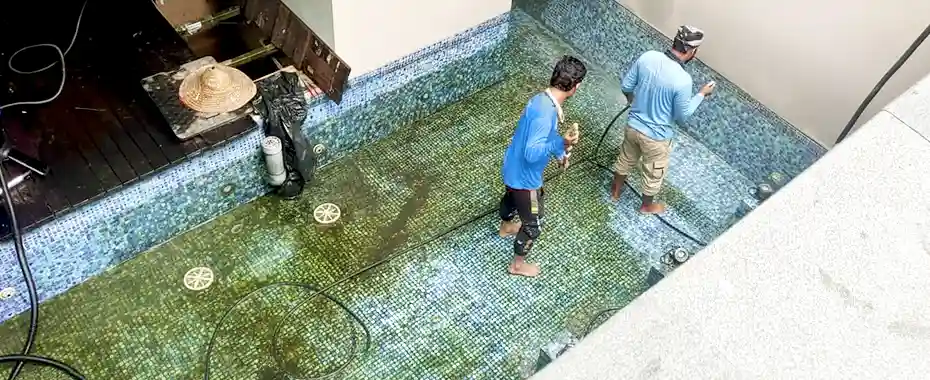
Swimming pool waterproofing is a crucial process that helps protect your pool’s structure from water-related damage. It involves applying a barrier that prevents water from leaking through the pool’s walls and floor, keeping the pool intact and functional. In Singapore’s humid climate, this is especially important to prevent expensive repairs, structural issues, and water loss. Good waterproofing makes your pool last longer, lowers maintenance costs, and keeps it safe for swimming. Choosing the right waterproofing method helps your swimming pool stay in top condition.
Why Swimming Pool Waterproofing in Singapore is Important?
Pool waterproofing keeps your swimming pool safe and stops water from leaking out. It protects the pool structure from damage and saves you lots of money. Waterproofing makes your pool last much longer and keeps the water clean. It stops harmful chemicals from seeping into the ground around your lovely pool. Good waterproofing prevents cracks and keeps your pool looking beautiful for many happy years.
A study from Springer Nature Link entitled “Technical and Sustainability Analysis of Construction Processes and Covering Systems for Outdoor Swimming Pools”, showed that outdoor swimming pools are common in villas and multifamily or tourist buildings. Construction choices depend on 7 key factors: design, soil type, function, aesthetics, durability, budget, and time. Comparative analysis evaluates cost, technical performance, and sustainability for informed decision-making. Another study from AIMS Press entitled “Biofilm associated with pigmented areas on a waterproofing coating surface”, showed that swimming pool waterproofing coatings identified 5 different stain types using colorimetry and microscopy. Biofilms with Chlorophyta and cyanobacteria formed on degraded topcoat areas. Although microbial growth caused visible discoloration, the damage remained superficial and did not affect watertight performance.
Benefits of pool leak protection:
- Swimming pool waterproofing stops water loss and helps you save money on water bills regularly.
- It prevents damage to the pool walls and floor from water pressure problems.
- It keeps your pool safe for swimming and protects your family from harm.
- It reduces repair costs because you won’t need to fix leaks very often.
- It makes your pool area cleaner and more hygienic for everyone to enjoy.
What Are the Different Types of Swimming Pool Waterproofing Processes?
Swimming pool waterproofing types include many different methods to protect your pool from leaks. Workers can use cement-based coatings, liquid membranes, or special sheets to stop water. Some pools need polyurethane coatings, whilst others work better with bituminous or crystalline treatments. Each type has special benefits and works differently depending on your pool’s specific needs. You must choose the right type to keep your pool completely safe and dry.
1. Cementitious Pool Waterproofing
Cementitious waterproofing uses a special cement mixture to coat your pool’s surface completely. Workers mix powder with water and brush it onto the pool walls carefully. This coating forms a hard layer that stops water from passing through effectively. It works very well for concrete pools and lasts for many long years.
A study from Science Direct entitled “Effect of cementitious capillary crystalline waterproof material on the mechanical behaviour of concrete” showed that cementitious capillary crystalline waterproofing (CCCW) shows strength depends on dosage and W/C ratio. At W/C 0.4, 0% CCCW achieved 54.82 MPa. For W/C 0.45 and 0.5, 0.5% CCCW delivered peak strengths of 50.98 MPa and 44.90 MP. Another study from Science Direct entitled “The mechanical and microstructural study on the cement pastes adding various cementitious capillary crystalline waterproof materials” showed that cementitious capillary crystalline waterproofing (CCCW) performance varies by type and dosage. Adding 0.5% LD increased 28-day compressive strength by 7.5%, while 0.5% SC reduced strength from 29.5 MPa to 20.2 MPa due to higher porosity, highlighting material selection importance.
Why Use Cementitious Waterproofing:
- It costs less money compared to other waterproofing methods available in Singapore today.
- It applies easily and dries quickly so you can use your pool soon.
- It bonds strongly with concrete surfaces and creates a very tight seal.
- It resists chemicals in pool water and keeps working properly for years.
- It handles Singapore’s hot weather very well without cracking or peeling off badly.
2. Liquid Pool Waterproofing Membrane
Liquid pool waterproofing membrane is a special coating that workers paint onto pools. It comes in liquid form and spreads easily over every surface and corner. When it dries, it forms a stretchy rubber-like layer that stops all water leaks. This membrane bends and moves with your pool without breaking or cracking at all.
A study from SSRN titled “Water-Resistance Performance Analysis of Portland Composite Concrete Containing Waterproofing Liquid Membrane” showed that adding 1.5% Sika® Membrane-2000 at a 0.40 water-binder ratio improved density and reduced voids. Water absorption was about 3% (static) and 6% (non-static) at 28 days, with strength reaching 34 MPa (CS) and 4 MPa (STS).
Benefits of Liquid Membrane:
- It covers every small crack and gap in your pool perfectly and completely.
- It creates a seamless coating with no joints where water could leak out.
- It works on different pool shapes including curved and irregular pool designs.
- It lasts very long and protects your pool from damage for many years.
- It applies quickly and workers can finish the job in just few days.
3. Sheet Membrane Pool Waterproofing
Sheet membrane pool waterproofing uses large sheets of waterproof material to cover pool surfaces. Workers stick these sheets onto the pool walls and floor using special strong glue. The sheets overlap each other to create a complete barrier against water leakage. This method works excellently for both new pools and old pools that need repair.
A study from Science Direct entitled “Influence of novel polymer waterproofing membrane on mechanical properties of tunnel lining structure”, showed that adhesive waterproofing membranes in tunnel linings used four-point bending tests to measure composite action. Results showed significant increases in beam strength and stiffness compared to sheet membranes, with composite performance improving as membrane thickness and interface stiffness increased. Another study from Science Direct entitled “Spray-applied waterproofing membranes in tunnelling: A construction perspective, showed that Spray-applied membranes offer a fast, flexible, and seamless waterproofing solution for tunnels, overcoming the labour-intensive installation of sheet membranes. Materials like EVA, SBR, and MMA are used, each with distinct performance properties. These membranes are suitable for complex geometries and can withstand pressures up to 5 bar.
Why Choose Sheet Membrane:
- It provides very strong protection that lasts for more than twenty long years.
- It resists tears and punctures better than many other waterproofing types available today.
- It handles ground movement without breaking because the sheets can stretch and bend.
- It installs faster than liquid coatings for large swimming pools in Singapore buildings.
- It works perfectly even in areas with high water pressure from underground sources.
4. PU (Polyurethane) Pool Waterproofing
PU polyurethane pool waterproofing is a modern coating that protects pools very effectively today. Workers apply this liquid coating that turns into a strong elastic rubber layer. It stretches easily and returns to its original shape without any damage at all. PU waterproofing handles temperature changes in Singapore’s climate without problems or cracks developing.
A study from MDPI entitled “Waterproof and Moisture-Permeable Polyurethane Nanofiber Membrane with High Strength, Launderability, and Durable Antimicrobial Properties” showed that A polyurethane-capped silver nanoparticle (AgNP) nanofiber membrane was created to enhance antibacterial properties and waterproofing. With silver content between 50-300 mg·kg−1, it showed high resistance to washing, with antibacterial efficacy remaining at 99.99% after 50 washes. The membrane’s moisture permeability was stable at 2600 g·m−2 per 24h. Another study conducted by Springer Nature Link entitled “Leaching of Polyurethane Systems for Waterproofing Purposes Whilest Curing”, investigates the leaching of polyurethane systems used for waterproofing buildings. Leaching tests revealed a maximum 0.004 mmol/l Zn and 612 mmol/l of organic compounds during early leaching steps. Ecotoxicological tests highlight the impact on the environment, especially with catalyst dosage.
Advantages of PU Waterproofing:
- It creates a very flexible coating that moves with your pool structure naturally.
- It resists harmful UV rays from the sun that can damage other coating types.
- It bonds excellently to concrete, tiles, and many other pool surface materials perfectly.
- It lasts extremely long and rarely needs repairs or replacement work done again.
- It applies smoothly and creates a beautiful finish that looks clean and professional.
5. Bituminous Pool Waterproofing
Bituminous pool waterproofing uses a special tar-like material to seal pools against water. Workers heat the bitumen and apply it in layers to build thick protection. This black coating sticks very strongly to concrete and creates an excellent water barrier. It has protected pools for many decades and still works wonderfully in Singapore.
A study from Nanotechnologies in Construction: A Scientific Internet-Journal entitled “Obtaining the retainer for waterproofing road bitumens”, explores the use of triethylenediaminedicyan as an additive for waterproofing road bitumen, enhancing its physical and mechanical properties. The study demonstrates significant improvements in bitumen grade CB 90/130, meeting GOST 33133-2014 standards. Another study conducted by Metallurgical and Materials Engineering (MME) entitled “Sustainable development in WPCBs treatment for production of bituminous waterproofing materials”, showed that explores the recycling of waste printed circuit boards (WPCBs) through vacuum pyrolysis, turning the by-product pyrolysis oil into solidified materials incorporated into bitumen at 2.5–10 wt.%. The resulting waterproofing materials were non-hazardous, except with sodium hydroxide-treated oil.
Uses of Bituminous Waterproofing:
- It works brilliantly for underground pools that face lots of water pressure constantly.
- It costs less than many modern waterproofing methods but still works very well.
- It handles extreme weather conditions including heavy rain and intense heat without failing.
- It lasts for many years when workers apply it correctly and with proper care.
- It seals cracks and gaps very effectively to stop even tiny water leaks.
6. Crystalline Pool Waterproofing
Crystalline pool waterproofing is a smart chemical treatment that blocks water from inside. Workers mix crystalline powder into concrete or apply it as a coating layer. The crystals grow inside concrete pores and seal them completely to stop water movement. This waterproofing actually heals small cracks by itself as crystals keep growing bigger.
A study from Science Direct titled “The mechanical and microstructural study on the cement pastes adding various cementitious capillary crystalline waterproof materials”, showed that investigates the impact of four cementitious capillary crystalline waterproof materials (CCCWs) on concrete properties. LD increased 28-day compressive strength by 7.5%, while SC decreased it from 29.5 MPa to 20.2 MPa. The right CCCW choice balances waterproof and mechanical properties. Another study conducted by Science Direct entitled “Influences of cementitious capillary crystalline waterproofing on the hydration products and properties of cement-based materials”, research on self-healing concrete with XYPEX-type CCCW admixture revealed that 2% internal CCCW enhanced self-healing by ~114.4%. Improved mechanical properties resulted from microstructure refinement, including hydration product generation and microcrack filling, prolonging concrete lifespan by reducing macropores.
Benefits of Crystalline Treatment:
- It penetrates deep into concrete and protects from inside the pool structure completely.
- It repairs itself when small cracks appear because crystals continue growing and spreading.
- It lasts forever as it becomes part of the concrete and never wears off.
- It allows concrete to breathe whilst still blocking all water from passing through effectively.
- It resists very high water pressure making it perfect for deep pools everywhere.
What Are the Common Causes of Swimming Pool Leakage?
Common causes of swimming pool leakage include cracks in concrete walls and floor tiles. Poor waterproofing during construction allows water to seep through the pool structure slowly. Ground movement and settling can create gaps where water escapes from your lovely pool. Tree roots growing nearby sometimes push against pool walls and cause damage and cracks. Chemical imbalance in pool water can eat away at surfaces and create holes.
Main Causes Include:
- Old age makes waterproofing layers weak and they stop working properly over time.
- Bad workmanship during pool building creates weak spots that develop leaks later on.
- Harsh weather conditions like heavy rain can damage pool surfaces and cause problems.
- Plumbing problems in pipes and fittings allow water to leak out constantly every day.
- Lack of regular maintenance means small problems grow into big expensive leaks quickly.
What Are the Common Signs of Swimming Pool Leakage?
Common signs of swimming pool leakage include water level dropping faster than normal evaporation. You might notice wet spots or puddles forming around your pool area regularly. Cracks appear on pool walls or floor and you can see them clearly. Your water bill increases suddenly even though you use the same amount daily. The ground around your pool feels soft or sinks down in certain spots.
Warning Signs to Watch:
- Pool equipment works harder than before and makes strange loud noises when running.
- Tiles become loose or fall off because water gets behind them constantly now.
- Algae grows more quickly even when you add chemicals and clean the pool.
- The pool deck develops cracks or moves away from the pool edge slowly.
- You need to add water more than twice weekly to maintain proper levels.
What Are the Best Swimming Pool Waterproofing Materials?
Best swimming pool waterproofing materials in Singapore include high-quality products that protect pools perfectly. Workers use epoxy coatings, polyurethane membranes, and acrylic sealers to stop water leaks effectively. These materials last very long and handle Singapore’s hot and humid weather extremely well. You can also find rubber membranes, cement-based coatings, and fibreglass materials in local shops. Choosing the right waterproofing material keeps your pool safe and prevents costly repairs in future.
Top Waterproofing Materials:
- Epoxy coatings create a very strong and chemical-resistant layer on pool surfaces today.
- Polyurethane membranes stretch easily and seal cracks without breaking or tearing at all.
- Acrylic sealers apply quickly and dry fast so you can use pools very soon.
- Rubber membranes bend with ground movement and last for more than twenty long years.
- Cement-based products cost less money but still provide excellent protection against water damage.
- Fibreglass sheets create smooth surfaces that look beautiful and resist algae growth very well.
What Are the Best Waterproof Paint for Swimming Pool?
Best waterproof paint for swimming pool in Singapore includes special coatings made for pools. These paints seal surfaces and create a beautiful finish that lasts for many years. Epoxy pool paint works brilliantly and resists chemicals and chlorine in water very effectively. Acrylic pool paint costs less and applies easily for homeowners who paint themselves. Rubber-based paint creates a flexible coating that moves with your pool without cracking badly.
1. Epoxy Paint for Swimming Pool
Epoxy paint lasts longest and handles heavy pool use without wearing off too quickly.A study from Wiley Online Library entitled “Corrosion protection performance of nanoparticle incorporated epoxy paint assessed by linear polarization and electrochemical impedance spectroscopy”, showed that A study evaluated epoxy paint with Al2O3(α), Fe2O3(α), SiO2, and ZnO nanoparticles at 1, 2, and 3 wt% for corrosion protection on carbon steel. The best performance was observed with 3 wt% Al2O3(α), improving corrosion resistance by reducing paint porosity.
2. Two-part Epoxy Paint for Pool
Two-part epoxy systems provide the strongest protection but need careful mixing before applying. A study from MDPI entitled “Development of an Online Monitoring Device for the Mixing Ratio of Two-Part Epoxy Adhesives Using an Electrical Impedance Spectroscopy Technique and Machine Learning”, showed that A machine learning-based sensor system was developed to monitor the mixing ratio of two-part epoxy adhesives, using impedance data from frequency and temperature changes. The system ensures precise mixing, improving adhesion performance by accurately estimating the mixing ratio.
3. Acrylic Paint for Swimming Pool
Acrylic paint dries faster and you can apply it without hiring expensive professional painters. A study from Wiley Online Library entitled “Corrosion protection performance of nanoparticle incorporated epoxy paint assessed by linear polarisation and electrochemical impedance spectroscopy”, showed that A study evaluated epoxy paint with Al2O3(α), Fe2O3(α), SiO2, and ZnO nanoparticles at 1, 2, and 3 wt% for corrosion protection on carbon steel. The best performance was observed with 3 wt% Al2O3(α), improving corrosion resistance by reducing paint porosity.
4. Chlorinated Rubber Paint for Swimming Pool
Chlorinated rubber paint resists pool chemicals excellently and maintains bright colours for years. A study from the Journal of Chemical Technology and Biotechnology entitled “High-build antifouling paints based on rosin and chlorinated rubber” showed that focused on developing high-thickness antifouling paints for ship hulls, using a ratio of WW rosin/chlorinated rubber (grade 10) and castor oil as a rheological agent. Tests showed good antifouling performance after 25 months of immersion.
5. Water-Based Paint for Swimming Pool
Water-based paint produces fewer fumes and makes painting safer for workers doing the job. A study conducted by Royal Society of Chemistry entitled An inorganic water-based paint for high-durability passive radiative cooling”, showed that The PRC-Al2O3 coating, with a solar reflectance of 0.96 and mid-infrared emissivity of 0.92, achieves a theoretical cooling power of 109 W m−2. After 72 hours of UV exposure, solar reflectance only decreased by 0.2%, ensuring long-lasting radiative cooling.
6. Using Premium Brands Paint
Premium brands like Jotun and Nippon make excellent pool paints sold in Singapore stores. A study from MDPI entitled “Children’s Exposure to Volatile Organic Compounds: A Comparative Analysis of Assessments in Households, Schools, and Indoor Swimming Pools”, showed that analysed VOC concentrations across 70 buildings, including homes, schools, and swimming pools in northern Portugal, revealing 16 VOCs. Swimming pools showed high levels of disinfection by-products. The study emphasises the need for regulations to monitor indoor air quality, especially for children.
How Do You Repair Leaks Using Swimming Pool Waterproofing?
Repair leaks using swimming pool waterproofing by first finding where water escapes from pools. Workers drain the pool completely and clean all surfaces to remove dirt and algae. They fill cracks with special sealant and let it dry properly before continuing work.
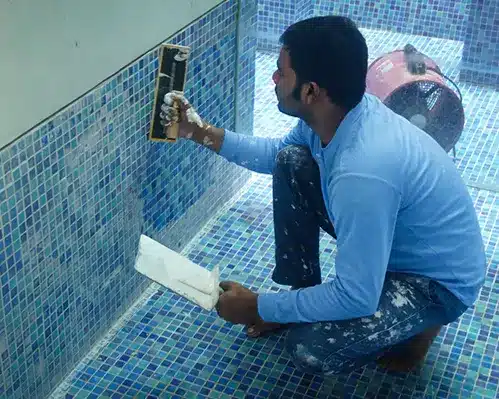
Next, they apply waterproofing coating in several layers to create strong protection against leaks. Finally, they test the pool by filling it with water and checking carefully.
Leak Repair Steps:
- Find leak locations by checking wet spots and using special dye tests carefully.
- Empty your pool fully and scrub walls and floor to remove all dirt completely.
- Remove loose concrete or tiles and prepare surfaces for new waterproofing materials properly.
- Fill all cracks and holes with repair mortar and smooth the surface nicely.
- Apply primer coat first to help waterproofing material stick better to pool surfaces.
- Add waterproofing layers and wait for each coat to dry completely before adding more.
- Refill the pool slowly and watch for any new leaks appearing over several days.
How Do You Maintain Swimming Pool Waterproofing?
The maintenance process of swimming pool waterproofing involves regular checks and cleaning. Look at your pool every month for cracks or peeling. Clean the pool walls and floor weekly to remove dirt and algae. This stops damage to the waterproof coating. Keep the water chemistry balanced because wrong chemicals can harm the waterproofing. Test the water twice a month and add the right chemicals.
Before beginning this project, make a simple maintenance plan. Follow these steps to keep waterproofing strong:
- Brush pool walls gently once a week
- Remove leaves and debris daily
- Fix small cracks immediately when you see them
- Drain and clean the pool fully once a year
- Get a professional check every two years
Don’t use sharp tools that scratch the waterproof surface. Avoid harsh chemicals that damage the coating. If you see water leaking or the coating peeling, call a professional quickly. Good maintenance makes your pool waterproofing last 10 years or more. This saves you money and keeps your pool safe for swimming.
How Do You Choose the Right Swimming Pool Waterproofing Contractor?
Choosing the right swimming pool waterproofing contractor requires careful research and asking important questions always. You must check their experience and see how many pools they have waterproofed successfully. Good contractors show you their past work and give you contact details of happy customers. They explain their waterproofing methods clearly and answer all your questions with patience and honesty. Licensed contractors provide proper warranties and use only high-quality materials for your lovely pool.
Important Selection Tips:
- Check if the contractor has valid licenses and insurance to protect you legally always.
- Ask for references and call previous customers to hear about their actual experiences.
- Compare quotes from at least three different contractors before making your final choice carefully.
- Look for contractors who specialise in pool waterproofing rather than general building work only.
- Read online reviews and ratings to learn what other people say about their services.
- Choose contractors who offer written warranties of at least five to ten good years.
- Make sure they explain the waterproofing process clearly in simple words you can understand.
- Avoid contractors who demand full payment upfront or offer prices that seem too cheap.
How Much Does Swimming Pool Waterproofing Cost in Singapore?
Waterproof a Swimming Pool in Singapore costs between $5,000 and $15,000. The price depends on the size of your pool. A small home pool costs less. A large pool needs more materials and work, so it costs more. The type of waterproofing you choose also affects the price. Better quality products cost more but last longer.
Before beginning this project, get quotes from several pool companies. The cost usually includes:
- Draining all the water from your pool
- Cleaning the pool surface properly
- Fixing any cracks or damage
- Applying waterproof coating layers
- Refilling the pool with clean water
Some pools need extra repairs which cost more. Always ask what the price includes. Good waterproofing stops leaks and keeps your pool safe. It saves you money on water bills and repair costs later.
What Is the Average Lifespan of a Swimming Pool?
The average lifespan of a swimming pool is 10 to 15 years with good care. Concrete pools last the longest, often 25 to 30 years. Fibreglass pools last around 20 to 25 years. The pool liner needs replacing every 10 to 15 years. How you maintain your pool makes a big difference to how long it lasts.
When you begin this project of owning a pool, plan for regular maintenance. Your pool lasts longer when you:
- Clean it every week
- Check the water chemistry monthly
- Fix small cracks quickly
- Replace worn parts on time
- Get professional inspections yearly
Singapore’s hot and humid weather affects pools. Rain and sun can damage the pool surface over time. Good waterproofing protects your pool and helps it last longer. Replace old waterproofing every 10 years to keep your pool in good condition.
FAQ’s
Yes, a pool needs to be waterproofed to prevent water from leaking out constantly. Without proper waterproofing, water seeps through concrete and damages the pool structure very badly. Waterproofing protects your pool from cracks and keeps it working perfectly for many years. It also saves money on water bills and prevents expensive repairs you don’t want. Every pool requires good waterproofing whether it is new or old for safety.
Reasons people put baking soda in their swimming pools include raising water pH levels. Baking soda makes acidic pool water less harsh on skin and pool equipment safely. It helps maintain proper alkalinity which keeps water clear and comfortable for happy swimmers. Pool owners use it because it costs much less than expensive commercial chemicals. Adding baking soda prevents corrosion of metal parts and protects your pool’s lovely surfaces.
What vinegar can do for a pool includes cleaning calcium deposits from tiles brilliantly. Vinegar removes stubborn stains and makes pool surfaces look shiny and new again quickly. It lowers pH levels in water if they become too high for swimming. Pool owners use vinegar because it is natural and safe for the environment. However, you need large amounts to treat entire pools so it works better.
You can put a pool directly on concrete if the surface is completely smooth. The concrete must be level and free from cracks or rough spots that damage. Above-ground pools need padding underneath to protect the liner from concrete’s hard surface. In-ground concrete pools need proper waterproofing before you fill them with water safely. Always prepare concrete surfaces properly to prevent damage and leaks from happening over time.
The expensive part of putting in an inground pool is excavation and concrete work. Digging the hole requires heavy machinery and skilled workers which costs lots of money. Pouring and shaping concrete takes time and needs experienced builders for quality results. Plumbing and electrical installations also add thousands of dollars to your total pool bill. These construction costs usually take up half of your entire pool building budget.
The cheapest way to fill in an inground pool is using dirt and gravel. You drill holes in the pool bottom for drainage then fill with gravel first. Next, you add layers of dirt and compact them down firmly and carefully. This method costs much less than removing the entire concrete pool structure completely. However, you must get proper permits and follow local building rules before starting work.