
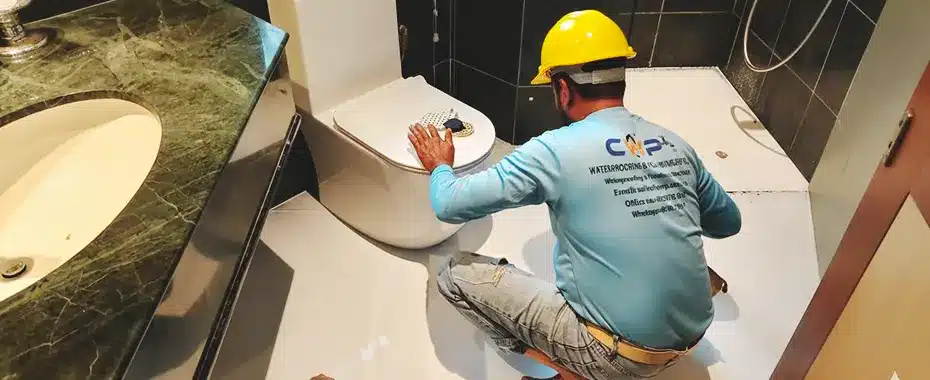
Chemical Infusion Waterproofing (or flood Infusion) is an advanced leak-sealing method that injects a chemical blend deep into walls, floors, and concrete to block moisture and stop active leaks. It forms internal crystals and films that strengthen and waterproof structures without surface hacking. Used in bathrooms, balconies, car parks, and basements, it offers fast, durable results lasting 5 to 10 years, with minimal disturbance and cost. Ideal for resolving seepage and dampness from the inside out.
What Is Chemical Infusion Waterproofing?
Chemical infusion waterproofing is a method that injects a formulated chemical solution deep into walls, floors, or concrete to seal cracks, stop water leaks, and block moisture. The solution uses a blend of organic and inorganic polymers that penetrate pores, crystallise, and form a tough, invisible barrier that keeps water out for years. It works from the inside of the structure, so it tackles the root of the leak, not just the surface.
What Are the Advantages and Disadvantages of Chemical Infusion Waterproofing?
Chemical infusion waterproofing offers a fast, non-invasive fix for leaks, but it does come with some limitations. Here is the pros and cons table below.
| Advantages | Disadvantages |
|---|---|
| No hacking or tile removal needed. | Requires skilled labour to apply correctly |
| Completes within a single day | VOCs in some solutions can cause headaches and irritation |
| Cost-effective compared to full repairs | Some chemicals contain biocides harmful to health |
| Lasts 5–10 years or more | May not work well if cracks are too large |
| Penetrates deep to seal from within | Chemicals can seep into soil and harm plants |
| Allows the surface to still “breathe” | No 30-year durability guarantee on all resins |
| Works on walls, floors, and pipe areas | Needs re-application if moisture source is not fixed |
What Are the Differences Between Chemical Infusion Waterproofing and PU Injection?
Chemical Infusion Waterproofing and PU Injection both methods stop water leaks by injecting material into cracks, but they use different chemicals and suit different situations. Here is the comparison table below.
| Feature | Chemical Infusion Waterproofing | PU (Polyurethane) Injection |
|---|---|---|
| Material used | Chemical-based solution | Expanding polyurethane resin |
| How it works | Crystallises and forms a film barrier | Expands and fills voids as it cures |
| Best use | Damp walls, floors, concrete seepage | Active water leaks in cracks and joints |
| Curing time | Slower; continues as moisture is present | Fast; short curing time |
| Crack size | Works well on porous surfaces and fine cracks | Effective on tiny cracks due to low viscosity |
| Flexibility | Moderate | Highly flexible after curing |
| Durability | 5–10 years or more | Long-lasting but varies by resin type |
What Are the Differences Between Chemical Infusion Waterproofing and Cementitious Waterproofing?
Chemical Infusion Waterproofing and Cementitious Waterproofing are two different methods of protecting structures from water damage. Chemical infusion works by penetrating deep into the material, while cement based waterproofing forms a rigid coating on top of the surface. See the comparison table below.
| Feature | Chemical Infusion Waterproofing | Cementitious Waterproofing |
|---|---|---|
| Application method | Injected or flooded into the substrate | Brushed or trowelled onto the surface |
| How it seals | Penetrates and crystallises inside the material | Forms a hard surface coating layer |
| Flexibility | Moderate; moves with the structure | Rigid; can crack under movement |
| Best for | Existing leaks, damp walls, bathrooms | New builds, basements, water tanks |
| Surface disruption | No hacking needed | Requires a clean and prepared surface |
| Durability | 5–10 years or more | Long-lasting but prone to cracking over time |
What Chemicals Are Used in Chemical Infusion Waterproofing?
Chemical infusion waterproofing uses a water‑based mix of organic and inorganic polymers. The organic part forms a flexible film that blocks water and resists chemicals. The inorganic part reacts with moisture and crystallises inside the pores of concrete. Some products also use a mild biocide and pH‑adjusting chemicals to protect steel. The most common chemicals include:
- Polyurethane (PU) resin
Polyurethane (PU) resin is a low‑viscosity liquid that professionals inject into concrete cracks. It mixes with water and expands to form a flexible, closed‑cell foam. This foam fills voids, stops water flow and seals active leaks under pressure. Engineers use it where movement and wet conditions happen in joints and seams.
A study published on International Journal of Adhesion and Adhesives entitled “Polyurethane resin-based adhesives: curing reaction and properties of cured systems” showed that strong mechanical and adhesion performance across multiple substrates. FT-IR analysis confirmed curing completion after approximately 100 hours at 25°C and 50% humidity. The resin contained 29.5% mineral residue after 650°C testing, demonstrating stable curing behavior and reliable adhesion on treated polypropylene and aluminum surfaces.
- Epoxy resin
Epoxy resin is a two‑part liquid that hardens into a very strong solid after curing. Contractors mix the base and hardener before injecting it into cracks or joints. It bonds tightly to concrete and restores structural strength and stiffness. People use it for high‑load areas such as bridges, beams and damaged foundations.
A study published in Carbon Letters entitled “The epoxy resin system: function and role of curing agents”, showed that Research highlights that curing agents are essential in aqueous epoxy systems but face limitations due to low emulsifying yield. Compared to commercial options, advanced curing agents show improved mechanical strength and thermal stability, supporting expanding industrial applications in coatings, adhesives, electronics, and construction sectors.
- Acrylic gel
Acrylic gel is a water‑based polymer that becomes a soft, flexible gel when injected. It flows into fine cracks and pores, then thickens to block water movement. It works well in low‑pressure leaks and non‑structural cracks. Engineers use it for cosmetic repairs, sealing joints and small wall leaks.
Research published in Analytica Chimica Acta entitled “A comparative study of the potential of acrylic and sol–gel polymers for molecular imprinting”, showed that comparing acrylic and sol–gel molecularly imprinted polymers for 2-aminopyridine found sol–gel achieved 100% template rebinding in chloroform versus 50% for acrylic. Standard deviation variations highlighted binding heterogeneity, while solvent type significantly influenced selectivity and hydrogen bonding performance.
- Sodium silicate
Sodium silicate is a water‑soluble glass‑like liquid that reacts quickly with water. Workers inject it into soil or cracks to form a gel or rigid silicate mass. It blocks water paths and stabilises loose ground around tunnels and shafts. It is common in temporary works, emergency sealing and ground improvement projects.
A study published in the journal Materiales de Construcción entitled “Sodium silicate solutions from dissolution of glasswastes. Statistical analysis”, showed that a study on four waste glass types (<45 µm and >125 µm) showed optimal sodium silicate generation using NaOH/Na₂CO₃ at 80 °C for 6 hours. Smaller particles (<45 µm) produced monomeric silicates, confirmed by ²⁹Si NMR MAS, suitable for alkaline cements.
- Hydrophobic injection resins
Hydrophobic injection resins are water‑repelling liquids that move away from water. Workers inject them into dry or low‑moisture cracks to form a solid, non‑swelling plug. They resist water under high pressure and stay stable in concrete voids. People use them for permanent sealing in basements, tunnels and underground tanks.
A study published in Energy Journal entitled “Molecular dynamics simulation of oil detachment from hydrophobic quartz surfaces during steam-surfactant Co-injection”, showed that hydrophobic injection resins with sulfur negatively affect bitumen detachment. Increasing pumping force from 10⁻⁵ to 10⁻⁴ Kcal/(mol·Å) improved recovery for sulphur-containing resins, while sulphur-free resins showed minimal change, guiding optimised steam-chemical co-injection formulations.
- Hydrophilic resins
Hydrophilic resins are water‑attracting liquids that expand when they meet moisture. Contractors inject them into cracks or joints where water is present. They swell into a flexible, tight plug that stops water and adapts to movement. Experts use them in leaking joints, expansion cracks and damp underground areas.
A study published in Case Studies in Construction Materials entitled “A novel bio-based waterproofing agent with lignosulfonate-encapsulated paraffin (LEP) against water absorption in wood-based composite” showed that a novel bio-based waterproofing agent using lignosulfonate-encapsulated paraffin (LEP) improved OSB performance, reducing thickness swelling to 7.36% (63% improvement), maintaining MOR (+19.86 %), MOE (+22.33 %), and increasing internal bonding by 173%, enhancing hydrophilic resin stability.
Where is Chemical Infusion Waterproofing Mostly Used?
Chemical infusion waterproofing is often used inside toilets, bathrooms, kitchens and balconies. People use it on concrete walls, ceilings and basements where water seeps in. It also works on underground tanks, parking areas and old buildings with damp patches. Builders choose it where they want to stop leaks without breaking tiles or concrete.
1. Toilet Chemical Infusion Waterproofing
Toilet chemical infusion waterproofing injects a special liquid into the floor and wall around the toilet area.
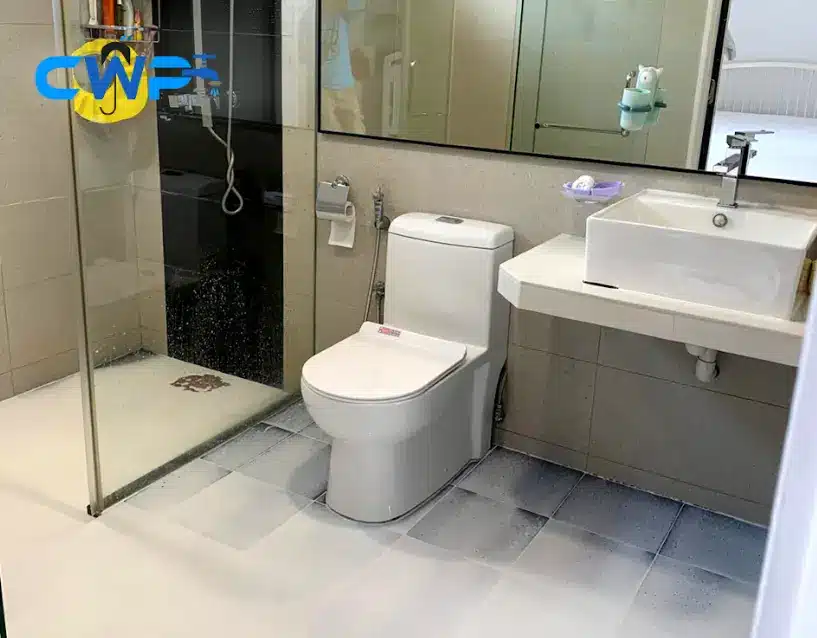
It fills tiny cracks and pores under and beside the tiles. This stops water from leaking down to the flat below and causing damp marks. Contractors use it as a fast, low‑hacking repair for recurring toilet leaks.
2. Bathroom Chemical Infusion Waterproofing
Bathroom chemical infusion waterproofing targets the floor and wet zones around the shower and basin. Technicians inject the chemical into the screed and joints without removing tiles. The liquid spreads inside the concrete and forms a hidden waterproof barrier. Engineers use it to solve long‑term damp and leakage in bathrooms safely and quietly.
3. Balcony Chemical Infusion Waterproofing
Balcony chemical Infusion Waterproofing seals the floor and edges of the balcony from the inside. Workers inject the chemical into the slab through small holes to reach hidden cracks. It forms a deep‑penetrating layer that resists rain, wind and UV exposure. People use it when the balcony leaks but they do not want to break the tiles.
4. Concrete Walls Chemical Infusion Waterproofing
Concrete walls chemical infusion waterproofing treats damp or leaky walls, including facade waterproofing, without removing paint. Contractors drill shallow holes and inject the liquid into the concrete. The chemical moves through pores and crystallises to block water paths permanently. Engineers use it for basements, underground walls, facades, and old buildings with seepage.
5. Ceilings Chemical Infusion Waterproofing
Ceilings chemical infusion waterproofing stops water from above by treating the ceiling from below. Technicians inject the solution into the slab through small holes drilled in the ceiling. The liquid spreads along cracks and forms an internal barrier that holds back dripping water. People use it when the neighbour above has leaks and hacking is not allowed.
6. Water Tanks Chemical Infusion Waterproofing
Water tanks chemical infusion waterproofing seals existing concrete or block‑work tanks without emptying them fully. Workers inject the chemical into the tank wall and joints to fill micro‑cracks. It creates a tight, non‑toxic layer that stops seepage and keeps the water clean. Engineers use it for old overhead or underground water tanks needing repair.
7. Car Parks Chemical Infusion Waterproofing
Car parks chemical infusion waterproofing protects the slab above shops or basements from dripping oil and water. Contractors inject the chemical along cracks, joints and around columns in the car‑park deck. It forms a tough, flexible shield that resists traffic loads and frequent wetting. Builders use it to stop leaks in multi‑storey car parks without closing the space.
How Do You Choose a Chemical Infusion Waterproofing Contractor?
Use this simple checklist to pick a good contractor for chemical infusion waterproofing. Focus on experience, materials, site checks and guarantees before you decide. The Key points to check:
- Contractor with proven experience: A contractor with proven experience has done many chemical infusion jobs on similar buildings. They can quickly find the real source of leaks and plan the right treatment. Their team follows safety rules and uses the correct tools and machines. You should ask for at least three recent project photos and references.
- Ask about chemicals used: Ask about chemicals used helps you check if the contractor uses safe, tested products. They should name the chemical type and share the manufacturer’s data sheet. Good contractors explain why that chemical suits your leak and if it is non‑toxic. This step avoids cheap or wrong materials that can fail later.
- Request a site inspection: Request a site inspection before finalising any contractor. They must visit your flat or building, walk through the wet area and mark the problem. They can then show you where they will inject and what will change. A site visit also helps you ask questions and understand the full plan.
- Compare detailed quotations: Compare detailed quotations from at least two or three contractors. Each quote should list materials, labour, drilling depth and number of holes. Check which items are included and which are extra. Choose the contractor who gives clear, honest pricing instead of only the lowest offer.
- Look at customer reviews and past projects: Look at customer reviews and Past projects to judge quality and trust. Read recent Google or local platform reviews for each company. Ask them for photos and contact details of two or three past clients. Talking to past users will tell you how they behaved on the site and afterwards.
- Ask for written warranty details: Ask for written warranty details before signing any agreement. The contractor should write the warranty period, what is covered and what is not. Check if they cover both material and labour for the same period. Keep a copy of this paper and note the contact if any leak reappears.
- Evaluate after‑service support: Evaluate after‑service support by asking how they handle complaints later. Good contractors give you a clear phone number and a short reply time. They should visit quickly if water comes back or if you see cracks or damp again. After‑service support tells you how serious they are about long‑term performance.
How Much Does Chemical Infusion Waterproofing Cost in Singapore?
Chemical Infusion Waterproofing in Singapore costs from a S$800 to a S$1500 per unit. The price depends on the flat size, number of leaks and how many rooms need treatment. Contractors often charge per room or per flat instead of per square metre. You should ask for a clear itemised quote before work starts.
How Long Does Chemical Infusion Waterproofing Take in Singapore?
Chemical Infusion Waterproofing in Singapore often takes one day to finish for a small flat. No hacking needed, and the area is ready within 24 hours, much faster than traditional methods that take 2 to 5 days. Teams drill holes, inject the chemical and let it dry without removing tiles. A simple toilet or bathroom job may only need a few hours. Larger flats or badly leaky walls can take extra time to complete fully.
How Long Does Chemical Infusion Waterproofing Last in Singapore?
Chemical Infusion Waterproofing in Singapore can last 1 to 5 years if the technician uses good chemicals. A proper seal in concrete or walls often protects against leaks for five to ten years. Lasting time also depends on how well the building drains and how much rain and moisture there is. Regular checks can help catch new leaks early.
FAQ’s About Flood Infusion Waterproofing
Chemical Infusion Waterproofing does need some simple checks and care to stay strong. Regular cleaning and quick fixing of new cracks help the seal last longer. Avoid heavy drilling or hacking near treated areas after the job is done. Ask the contractor what they suggest for yearly checks and repairs.
Yes, small drilling is usually needed to let the chemical reach the leak path inside the wall or floor. Drilling is quick, and the holes are very small. The team seals the holes after injection so they look almost invisible. Drilling helps the chemical spread deep and form a strong waterproof layer.
Chemical Infusion Waterproofing works well for many types of water leakage in walls and floors. It seals tiny cracks and pores from the inside so water cannot pass through. Its success depends on correct diagnosis and proper chemical choice. It is not a magic fix for all problems, but it helps in most damp and leak cases.
Yes, Chemical Infusion Waterproofing can stop active leaks by sealing the exact path where water flows. The chemical moves into the crack and hardens or crystallises to block the flow. It works best when the source is clear and the contractor injects in the right place. Some strong leaks may need extra support or a different method.
Yes, Chemical Infusion Waterproofing is good for concrete floors that get damp or leak. The chemical spreads inside the slab and fills tiny pores and cracks. It forms a hidden waterproof layer without removing tiles or screed. People use it on basements, car parks and bathroom floors successfully.
Flood infusion can help with some swimming pool leaks, but it is not always the best choice. It works better for small seepage from cracks in the pool shell. Large leaks or liner damage still need traditional repair methods. Always ask a specialist to inspect the pool before deciding on the treatment.
Flood infusion is usually safe for water tanks if the contractor uses food‑grade or potable‑water approved chemicals. The chemical seals cracks from the inside without changing the water quality. Always check the product data sheet and ask for a written safety note. It is good for old tanks with minor seepage but not for badly damaged ones.